An employee welcome kit should do more than fill a box: it should make a new hire’s first days easier and help them feel part of the team. The most useful employee welcome kit ideas combine practical work essentials, a personal note and thoughtful extras. Each item should help remove onboarding friction, reinforce company culture or create a consistent welcome across teams and hiring batches.
Branded items can make a new hire feel included, but a kit feels more thoughtful when every item has a purpose and suits the employee’s work. Pair useful gifts with a message that feels personal, rather than treating the logo as the whole welcome.
This guide explores what to include, from notebooks and bags to optional snacks, and how packaging, branding and delivery can shape the experience. You’ll also find ways to adapt the kit for different roles and remote or hybrid work, so the welcome feels practical and aligned with your company culture.
Key Takeaways
- Build the kit around the new hire’s role, work setting and first-week tasks, so each item has a clear purpose.
- Choose a small set of useful desk essentials and pair them with packaging that feels polished without overpowering the contents.
- Make a standard kit feel personal with a welcome note that mentions the employee’s role, team or next steps.
- Treat snacks as optional extras, considering dietary preferences and choosing items that keep well.
- Plan delivery around the employee’s start date, with remote and hybrid hires’ workspaces and shipping timelines in mind.
1. What is an employee welcome kit?
An employee welcome kit is a curated set of practical items and information for a new hire. It can remove onboarding friction, reinforce company culture and create a consistent experience across teams. A welcome letter, first-week schedule and branded notebook, for example, can help someone understand what happens next. A kit may also include policies, contracts or an employee handbook for review before work begins.
Start with the employee’s role, work environment and first-week needs, then set a budget per hire. Prioritise items that support real tasks, such as taking induction notes or carrying a laptop. This ties spending to usefulness, not the number of items. If kits vary by role or seniority, aim for similar perceived value so employees don’t see the differences as favouritism.
Branding should express company values without making every item feel like an advertisement. Choose a clear logo placement, restrained colours and useful products that employees can use beyond orientation. A reusable tote, notebook or travel accessory can carry the company identity subtly. For a sustainability-focused culture, reusable items such as a recycled canvas tote, bamboo notebook, wheat-straw pen or bamboo tumbler make that priority visible.
Branded apparel can build team spirit when it suits everyday wear. Consider a T-shirt or hoodie with a comfortable fit and discreet logo placement. Employees are more likely to wear it beyond introductions if it feels like clothing, not a uniform. Other merchandise, such as tote bags, socks, caps, stickers or mugs, should likewise suit the employee’s work and preferences.
Drinkware earns a place in a kit when it fits daily routines. A reusable bottle or tumbler can sit alongside a notebook and pen, providing practical tools for meetings and desk work. Choose for everyday usefulness rather than to make the package larger. A reusable bag can also bring the items together as both packaging and a lasting gift.
Singapore businesses can source or customise welcome-kit components through corporate gifting providers offering business stationery, electronic corporate gifts and luxury corporate gifts. Select items around the employee’s role, then align branding and packaging across the set. For fulfillment, organise names, sizes, office locations and joining dates before preparing each kit. A repeatable process helps teams maintain consistency across hiring batches, while delivery before the start date gives new hires time to receive the materials.
2. Desk essentials, welcome notes, packaging, and snacks
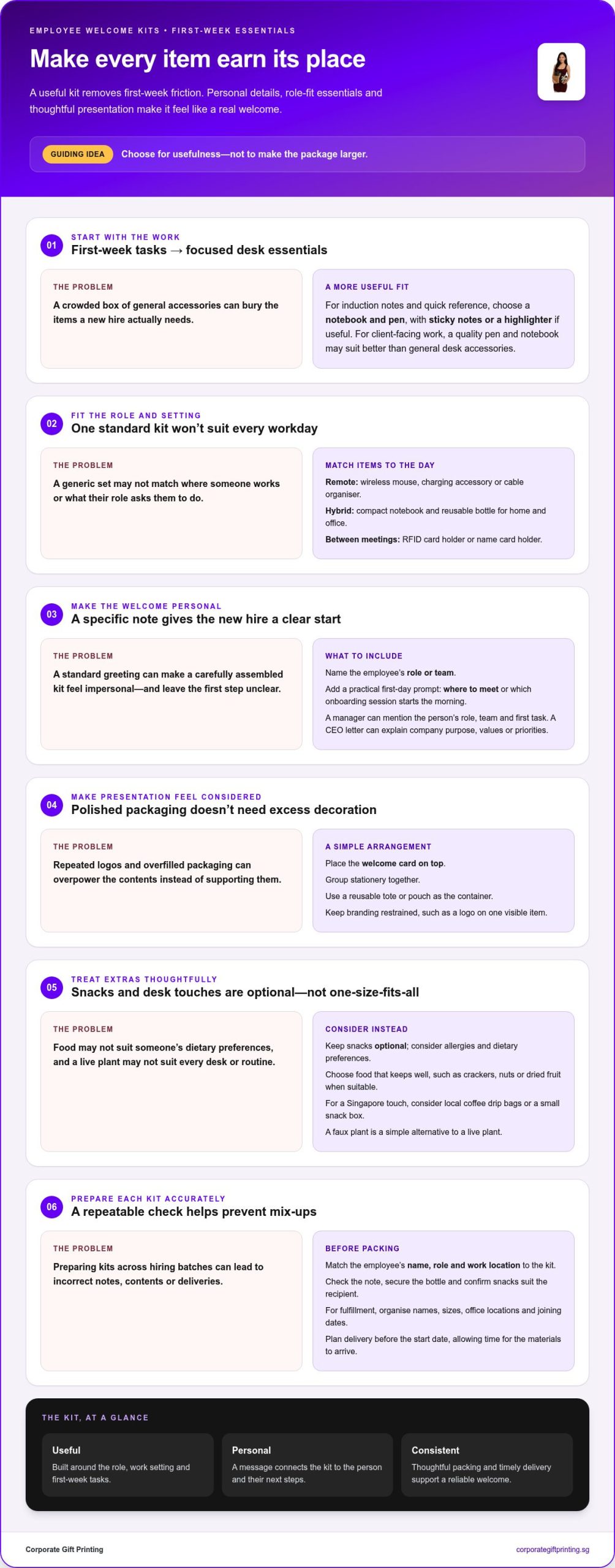
Choose desk essentials for the tasks a new hire will handle during the first week. A notebook and pen help capture induction details, while sticky notes or a highlighter support quick reference. Keep the selection focused: a few useful items can work better than a crowded box. For someone who meets clients, a quality pen and notebook may be more suitable than general desk accessories.
Match the kit to the work setting, too. A remote employee may appreciate a wireless mouse, charging accessory or cable organiser, while a hybrid worker could use a compact notebook and reusable bottle at both home and office. For someone moving between meetings, an RFID card holder or name card holder keeps everyday essentials together. These role-based choices make practical employee welcome kit ideas feel considered, not generic.
Make the welcome note specific by mentioning one detail about the person’s role or team. “We’re excited to have you join the design team” feels more personal than a standard greeting. Add a practical first-day prompt, such as where to meet the team or which onboarding session starts the morning. That small touch gives the new hire a clear starting point.
Packaging creates a first impression before the employee sees the contents. Place a welcome card on top, group stationery together and use a reusable tote or pouch as the container. A tidy arrangement can feel polished without excess decoration. Keep branding restrained, perhaps with a logo on one visible item rather than repeated across every surface.
For a cozy welcome, pair a reusable bottle with a notebook, a desk decoration and a snack that keeps well. A faux plant offers a simple alternative to a live plant for different desks and routines. In Singapore, local coffee drip bags or a small snack box can add a familiar touch. Treat food as optional, and consider allergies and dietary preferences before including snacks such as crackers, nuts or dried fruit.
Creative and practical choices depend on the role: combine a notebook and pen for onboarding, a card holder for client-facing work, or charging accessories for a remote setup. For Singapore-based teams, local coffee and snacks can make the package feel rooted in place without displacing useful work essentials.
Before packing, match each employee’s name, role and work location to the kit contents. Check that the note is correct, the bottle is secure, and snacks are suitable for the recipient. This simple preparation helps avoid mix-ups across hiring batches. If you’re shaping a coordinated set of corporate welcome-kit gifts, consider how useful accessories, packaging and branding will work together after the first day.
3. Personal welcome notes from managers and the CEO
A personal message can make a standard welcome kit feel prepared for one person. Ask the line manager to write a brief note naming the employee’s role, team and first task. For example: “Welcome to the product team. I’m looking forward to meeting you at our project introduction.” This connects the gift to a real working relationship rather than relying on a generic greeting.
A CEO’s welcome letter can offer a different perspective. Use it to explain the company’s purpose, values or priorities in direct, specific language. The manager’s note can cover practical details, such as where to meet, who will introduce the team or what to bring. Together, the messages offer a senior-level welcome and a useful point of contact for the first day.
Personalisation works best when it respects the employee’s preferences and keeps the kit useful. If an interview conversation revealed an interest in cycling, for example, a relevant accessory may feel thoughtful. A notebook, pen or work accessory can still serve everyday needs, while a personal detail makes the selection feel less standardised. Don’t add items simply because they can carry a name; choose details that fit the person and role.
Keep the notes concise and actionable. Include the employee’s name, team, manager’s name and one clear next step. For example: “Please meet Priya for your onboarding introduction.” Check spelling, role titles and meeting details against the joining information before packing. For remote employees, replace in-person directions with the video meeting link or the name of their first online session.
Delivery timing matters as much as the message. Coordinate the kit’s arrival with the employee’s start date so the welcome feels connected to the first day. For a remote hire, arrange shipment early enough for the package to arrive before work begins. Confirm the delivery address, employee name and joining date in the fulfilment record. These checks help prevent a thoughtful gift arriving late or at the wrong address.
Treat snacks as optional additions, not the focus of the welcome. A small, shelf-stable treat can accompany a card, but dietary preferences and allergies matter. If food isn’t suitable, a useful desk item or team-signed card can convey the same thoughtfulness. Ask the manager to add a genuine sentence about the person’s contribution rather than relying on polished but impersonal wording.
Before sealing the package, match each card to its recipient and check that the manager’s note, CEO letter and onboarding details agree. This final review keeps the welcome personal and the practical information clear. The result is a kit that helps a new colleague feel expected, prepared and connected to the people they’ll meet.
4. Welcome kits as a signal of company culture
A new hire can form an impression of a company in the first 10 minutes. Welcome kits contribute to that moment through their contents, presentation and message. A practical water bottle, for example, signals everyday usefulness, while a carefully chosen reusable item can reflect environmental values. The strongest choices connect a company’s stated culture with something the employee can use.
An employee handbook can make company values tangible. Include a concise introduction to the organisation’s purpose, working principles and communication norms, then direct employees to fuller guidance. A welcome card might explain how the team collaborates, while the handbook describes shared values such as learning or sustainability. This gives a new colleague useful context, rather than reducing culture to a logo.
Examples from well-known companies can inspire, but work best as prompts rather than templates. A technology company might choose useful accessories that support employees’ work; a sustainability-focused organisation could select reusable items. Adapt ideas to your own values, role requirements and team habits. A kit that feels authentic to your workplace communicates more than a copy of another brand’s style.
Wearable company apparel can express belonging when employees would choose to wear it outside orientation. Consider a comfortable T-shirt or hoodie, then review fabric, fit and logo placement before selecting the design. A small, discreet mark can feel more versatile than a large logo across the chest. If apparel does not suit the team’s daily routines, a tote or water bottle can carry the same identity in a practical form.
Teams include people with varied cultural backgrounds, so don’t assume everyone shares the same food preferences or practices. Ask about dietary needs and allergies before packing snacks, and consider a non-food alternative such as a notebook. For food gifts, individually packaged options with clear ingredient information help employees make an informed choice. This keeps the welcome inclusive without asking anyone to explain personal needs publicly.
Before preparing each batch, check that every item reflects a company value and is useful, and remove anything that feels purely decorative. For a team that values collaboration, a shared welcome message or team-signed card can make that principle visible. For a sustainability-minded workplace, consider reusable items and packaging. These choices create a consistent experience across teams while leaving room for personal touches.
5. Welcome kits for remote and hybrid employees
A remote employee’s kit should support a home workspace, not assume an office desk. Start with tools needed for first-week tasks, such as a laptop stand, keyboard, mouse, USB hub or cable organiser. For a hybrid hire, choose accessories that are easy to carry between home and office. A notebook and reusable bottle can complement work equipment without adding unnecessary bulk.
Match technology to the devices and work the employee will actually use. Check compatibility, quality and safety when selecting chargers, adaptors, headphones or other tech accessories. A webcam cover or wireless mouse may suit someone who spends time in video meetings; another role may need different equipment. Keep the selection intentional: each item should meet a practical work need, not simply make the package look fuller.
Personalise remote and hybrid welcome kits with details that connect the recipient to the team. Include the employee’s name, role and a welcome note from their manager, then add a first-day schedule or introductory meeting details. A team-signed card can make a remote arrival feel more connected. Tailor the contents to the person’s workspace, role and first-week tasks instead of relying on an office-based template.
Timing shapes the presentation. Arrange shipment early enough for the kit to arrive before the employee’s first day, and coordinate the delivery address and joining date with the onboarding schedule. For hybrid hires, confirm whether the package should go to a home or office address. An organised dispatch helps ensure the employee receives materials before setup or introductory meetings begin.
A gift card to a local restaurant can offer a meal to enjoy with family or make mealtime easier during a new job’s adjustment period. In Singapore, this can complement practical work items without requiring food in the package. If adding snacks instead, consider dietary preferences and allergies. A reusable bottle, travel accessory or desk item provides an alternative when food gifts aren’t suitable.
For repeat hiring, create a consistent core kit and tailor selected items to each role. Keep shared elements, such as a welcome note and onboarding details, while adapting accessories for home- or office-based work. This makes batches easier to organise and gives remote employees the same welcome experience. Personal touches can come from the message, team connection and considered choice of useful items.
Planning a coordinated kit for remote colleagues? Explore remote-work gift options to bring practical accessories and a considered presentation together.
Corporate Gift Printing: Customized Bags & Pouches
Corporate Gift Printing helps businesses turn employee welcome-kit plans into practical, branded gifts. Customized Bags & Pouches can serve as useful items or packaging, while Business Stationeries, Electronic Corporate Gifts and Travel Accessories can suit different roles and work settings.
Turn to Corporate Gift Printing when you’ve chosen the kit’s purpose and want coordinated items that reflect your company identity. A branded pouch can hold stationery or small work accessories, while a bag can carry essentials between home and office. Choosing items around employees’ needs keeps the welcome thoughtful and useful beyond the first day.
Share your kit concept and the items you’d like to bring together. Contact Corporate Gift Printing to discuss your employee welcome kit.
Make the First Welcome Feel Intentional
Treat each new hire’s arrival as the beginning of a relationship, not a one-day gesture. A consistent welcome can still feel personal when its message reflects the person’s role and the selected items suit how they work. Use your employee welcome kit ideas as a starting point, then decide what to keep consistent across hiring batches and what to tailor to each team.
That direction makes it easier to bring a welcome concept together as a cohesive set. Corporate Gift Printing offers Customized Bags & Pouches, Electronic Corporate Gifts and Travel Accessories for employee gifting. Choose items that fit the intended experience and carry your company identity with care.
Ready to shape a thoughtful welcome kit for your team? Contact Corporate Gift Printing to discuss your corporate gifting requirements. A considered first welcome can help new colleagues begin with a stronger sense of connection.
Frequently Asked Questions
What is an employee welcome kit?
An employee welcome kit is a prepared set of resources and gifts that helps a new colleague start work with essential information close at hand. It can combine a welcome letter, key contacts, benefits information and a first-week agenda with useful items. For example, a new hire could receive a team contact list with their induction schedule, making it easier to know whom to approach and what happens next.
What items should be included in an employee welcome kit?
Include onboarding information and items suited to the employee’s work. A practical checklist might cover an employee handbook, benefits information, HR forms, key contacts and a first-week agenda. Then consider a role-specific item, such as a device case for someone who travels between meetings. Keep optional extras separate from essentials so recipients can find important documents quickly and see which materials need attention first.
How much does an employee welcome kit cost in Singapore?
The total cost in Singapore depends on the selected gifts, customisation, order quantity and packaging or delivery requirements. A set centred on stationery will differ from one that includes electronic gifts or travel accessories. To plan spending, decide which items are essential, then request a quote based on the intended contents and branding. This gives your team a project-specific figure without relying on a generic estimate that may not fit.
When should a new employee receive their welcome kit?
Plan for the kit to arrive before the employee’s start date so key materials are ready when onboarding begins. Coordinate delivery with the joining date and first-day arrangements. For a remote employee, for example, arrange for necessary materials to arrive before the first online induction session. Allow time to prepare and dispatch the package, especially when several new hires are joining in a batch.
How can companies assemble and distribute employee welcome kits efficiently?
Create a repeatable fulfilment checklist for each hiring batch. Record every employee’s name, role, size requirements, delivery address and joining date, then separate shared kit contents from role-specific items. Assign someone to check each recipient’s details against the package before dispatch. For teams in different locations, group shipments by destination and record which kits contain time-sensitive onboarding documents.