The best branded gift fits the relationship before it carries the logo. Choosing branded business gifts Singapore companies can give with confidence means looking beyond the imprint: a useful item for a client may differ from a suitable gift for a colleague or business partner. When a logo dominates the design, even a well-chosen gift can feel more like an advertisement than a thoughtful gesture.
To strike the right balance, start with the recipient and the purpose of the gift. Then consider the item’s likely use, how its design will represent your brand and how it will be presented. These choices help the gift feel relevant to the recipient while giving your organisation a clear, professional presence.
This guide takes you from a gifting brief to a customised choice. It compares bags and pouches, electronic gifts, travel accessories, business stationery and luxury corporate gifts, with practical criteria for weighing usefulness, brand fit and presentation. Use it to narrow your options and prepare a brief that keeps the recipient at the centre.
Key Takeaways
- Define the gift’s purpose and recipient before choosing an item.
- Compare categories by likely use and the impression you want to create.
- For branded business gifts Singapore companies give, plan logo size, placement and colour to suit the item’s surface.
- Prepare a brief with the audience, occasion, preferred category, brand assets and presentation expectations.
- Bring the brief to life through considered sourcing, customisation and company logo printing.
What Makes Branded Business Gifts in Singapore Meaningful?
A business gift is branded when customisation connects the item to an organisation, often through its name, logo or other brand elements. But branding alone doesn’t make a gift meaningful. The recipient should understand why the item was chosen, not just which company supplied it.
Usefulness, recipient fit and presentation shape that impression. An item suited to someone’s work, travel or everyday routine is more likely to feel relevant. Considered packaging and restrained branding can reinforce the gesture, while keeping the human purpose ahead of the logo.
This distinction matters when planning branded business gifts Singapore companies give to clients, employees or partners. A gift intended to strengthen a professional relationship serves a different purpose from a broad promotional giveaway. Giveaways often prioritise reach and visibility; relationship-building gifts acknowledge a particular person, contribution or connection. The broader context of the history and social significance of gift-giving helps explain why the gesture can mean more than the item itself.
What role can a branded gift play in a business relationship?
A thoughtful gift can recognise a client’s continued trust, thank a partner for a close collaboration, acknowledge an employee’s contribution or mark a professional milestone. Keep the recipient central: choose something that suits the occasion and is likely to be useful, then use the logo as a subtle reminder of who gave it.
For example, a travel accessory may suit a partner who frequently travels for work, while a gift chosen for an employee’s work routine may call for a different category. In both cases, the purpose is to communicate appreciation. Branding supports that message rather than turning the exchange into an advertisement.
When should a company consider a branded business gift?
Gifts can mark client appreciation, employee recognition, partner engagement and corporate occasions. Companies in Singapore may also consider dates such as Chinese New Year, Hari Raya Puasa, Deepavali and National Day as opportunities to express appreciation. The occasion provides context, but it doesn’t make the same gift appropriate for every recipient.
Before choosing an item or timing, consider the relationship, the reason for giving and the recipient’s preferences. A personal milestone may call for a different gesture from a company-wide occasion. Avoid assumptions based on someone’s identity or the calendar alone. A relevant choice, presented with care and a clear purpose, is more likely to feel sincere than a standard item distributed without consideration.
How to Match a Business Gift to Its Recipient and Purpose
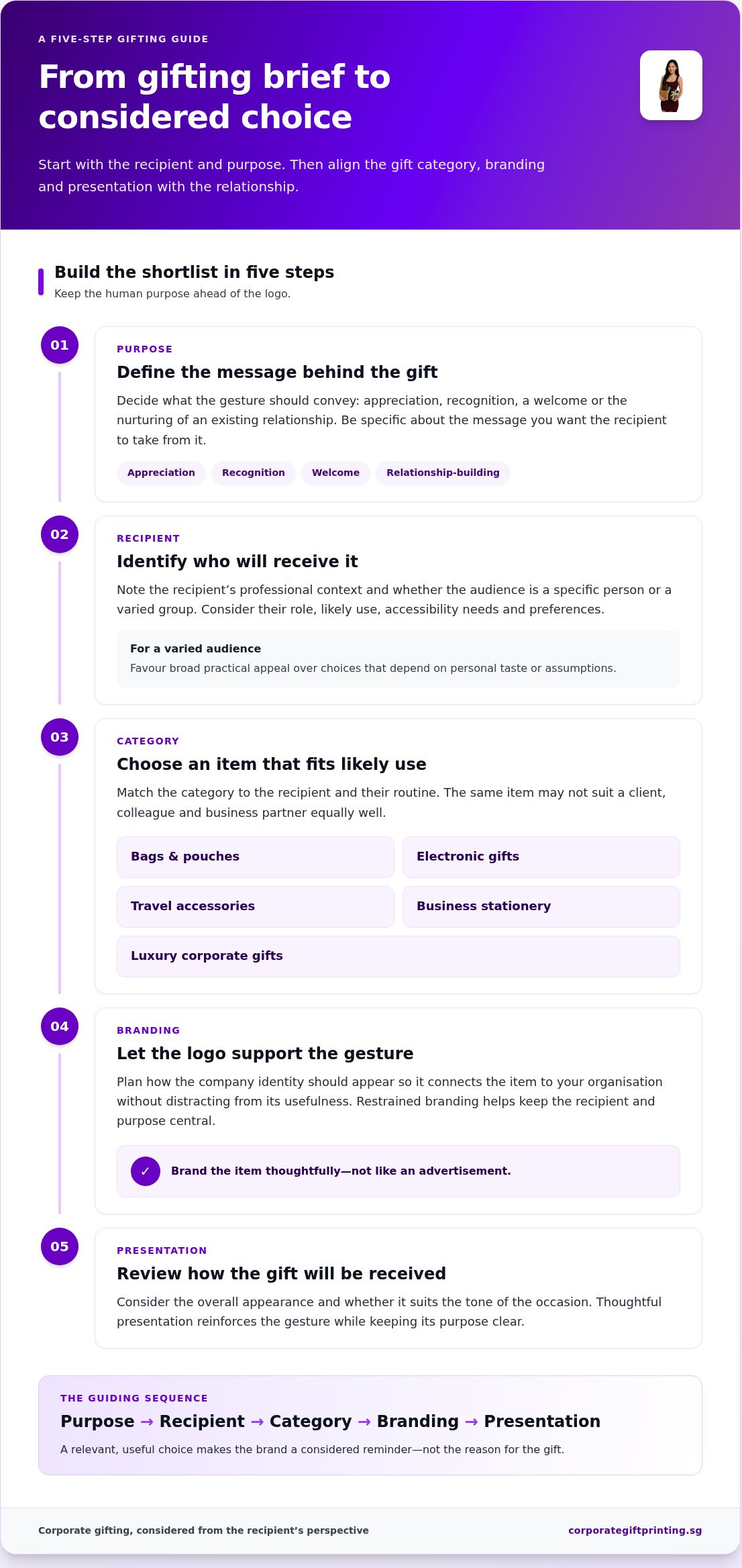
A suitable gift starts with the recipient, not the logo size or the item that is easiest to source. A clear process turns a broad intention into a choice that feels relevant, represents the organisation well and suits the relationship. Use these five steps to build a shortlist:
- Define the purpose. Decide whether the gift is meant to show appreciation, recognise a contribution, welcome someone or nurture an existing relationship. Be specific about the message you want the gesture to convey.
- Identify the recipients. Note who will receive the gift, their professional context and whether the audience is a specific person or a varied group.
- Choose a category. Consider bags and pouches, electronic corporate gifts, travel accessories, business stationery or luxury corporate gifts. Match the category to the recipient and likely use.
- Plan the branding. Decide how the company identity should appear. The logo should connect the item to your organisation without distracting from its usefulness.
- Review the presentation. Consider how the gift will be received and whether its overall appearance suits the tone of the occasion.
Match the gift’s purpose to the recipient, then align the category, branding and presentation with that choice.
How do you define the gift’s purpose before choosing an item?
Begin by naming the feeling or message you want to convey. Appreciation may call for a useful gesture that says “thank you”; recognition could mark someone’s contribution; a welcome gift can help a new employee or partner feel included. Nurturing a relationship may call for an item that reflects an ongoing professional connection. These aims differ, so avoid treating one generic gift as the answer to all of them.
Keep the business objective clear, but don’t treat the gift as a promise of a particular result. The purpose guides the decision; it doesn’t guarantee a response or measurable business outcome.
How can recipient preferences shape the shortlist?
Consider the recipient’s role, likely use for the item, accessibility needs and professional context. Employees may appreciate something suited to their working routine, while a client gift should reflect the nature of the relationship. A partner’s day-to-day needs may point to another category. For a varied audience, favour broad practical appeal over choices that depend on personal taste or assumptions.
Capture these considerations in a brief before sourcing begins. Record the audience, occasion, intended message, likely use and relevant preferences. This gives the selection process a clear reference point and helps keep decisions consistent when several people are involved. For a nationwide audience, make the brief useful across different recipient groups rather than relying on assumptions about one workplace or location.
Once the brief is clear, customised corporate gift sourcing can turn the preferred category and branding direction into a considered item. Keep the recipient at the centre as the idea moves from purpose to presentation.
Compare Branded Business Gift Categories by Use and Impression
The right category depends on what the recipient is likely to use and the impression the gift should convey. Compare options using the same criteria: likely use, recipient fit and how branding will work on the item. The guide below is a starting point for choosing branded business gifts Singapore organisations can tailor to different recipients and purposes.
| Gift category | Common use case | Potential recipient fit | Branding consideration |
|---|---|---|---|
| Bags and pouches | A practical item for everyday routines | Recipients who can use a carry or storage item in their work or daily life | Consider how logo size and placement affect the item’s overall appearance. |
| Electronic corporate gifts | A gift chosen to support a recipient’s work or personal routines | People whose needs make an electronic gift relevant | Keep branding clear and balanced with the item’s design. |
| Travel accessories | A gesture for recipients who travel for work or other purposes | Clients, partners or employees for whom travel is part of their context | Choose a presentation that feels professional and appropriate for the relationship. |
| Business stationery | A work-related gift for professional use | Recipients who are likely to value stationery in their working routines | Make the brand identity legible without overwhelming the item. |
| Luxury corporate gifts | A more elevated gesture for a significant relationship or occasion | Recipients and contexts suited to a more formal presentation | Align the branding and presentation with the intended level of formality. |
Which gift category suits each business occasion?
Bags and pouches are worth considering when practical everyday use is the priority. Electronic gifts and travel accessories make sense when they connect naturally to the recipient’s routine, rather than simply because they seem impressive. Business stationery offers a work-focused option, while luxury corporate gifts may suit a more formal relationship or occasion. None is automatically the right choice: let the recipient and purpose guide the decision.
For more detail on business stationery or luxury corporate gifts, consult the dedicated guides alongside this comparison. They can help refine category-specific considerations once you’ve identified the recipient and the impression you want to create.
How should you compare everyday and premium gift options?
Compare each option by likely usefulness, formality and fit with the relationship. An everyday item may suit a broad group when it fits their routines. A premium-positioned gift may feel more considered for a significant occasion, but the label alone doesn’t make it thoughtful. Relevance and quality matter more than making a gift appear costly.
Select the category that best fits the recipient’s needs and the relationship, then let the branding and presentation reinforce that choice. This keeps the impression coherent: an appropriate item, a clear connection to your organisation and no more branding than the gift needs.
Plan the Branding and Brief Before Customising Business Gifts
A clear brief connects the reason for giving a gift to the item and the way your brand appears on it. For branded business gifts Singapore companies prepare for clients, employees or partners, this planning step keeps the choice relevant and the visual identity consistent. It also gives everyone involved a shared reference before customisation begins.
What should a corporate gifting brief include?
Capture the essentials in one place so the gift can be assessed against its purpose, audience and presentation. A useful brief can include:
- Occasion and purpose: Record what is being marked and the intended message, such as appreciation, welcome or recognition.
- Recipient group: Describe who will receive the gift and any relevant preferences, roles or professional context.
- Preferred category: Note the category under consideration, such as bags and pouches, electronic gifts, travel accessories, business stationery or luxury corporate gifts.
- Brand assets: Gather the approved logo and any relevant brand colours or usage guidance.
- Quantity and distribution: State how many recipients the brief covers and how the gifts will be distributed, without assuming that every recipient has the same needs.
- Presentation expectations: Describe the impression the finished gift should create, from understated and practical to more formal.
Identify who will review the artwork and give final approval. A clear approval path can catch misplaced logos, unsuitable colours or presentation choices that don’t match the brief. Agreeing on what needs approval before production also makes feedback more focused.
How can branding complement rather than dominate a gift?
A logo should be recognisable, but it doesn’t need to take over the item. Size and placement affect visual balance, while the surface and shape influence how the mark sits within the design. Use the organisation’s approved brand assets and consider how the colours appear against the item, rather than assuming the logo will look identical on every surface.
Think about the gift in use. A prominent mark may suit a highly visible promotional item, while a more restrained treatment can feel appropriate for a personal client or partner gift. The aim is to make the organisation identifiable without making the recipient feel like an advertising surface. The printing approach should suit the item and the intended presentation.
Before approving the artwork, review it in context. Check that the logo is legible, its placement feels balanced and the presentation suits the occasion. If the item or branding changes, review the updated proof rather than relying on an earlier approval.
With the audience, brand assets and approval expectations in place, a gifting brief can become a considered custom item. Custom corporate gift solutions bring together sourcing, customisation and company logo printing.
Bring Your Branded Business Gift Idea to Life with Corporate Gift Printing
A strong corporate gift takes shape through connected decisions: define the purpose, identify the recipient, select a suitable category, prepare the branding and plan the presentation. Each step guides the next. For companies planning branded business gifts Singapore-wide, a clear brief helps keep the idea consistent from the initial objective to the customised item.
How does a gifting idea become a customised corporate gift?
Start by connecting four essentials: the business objective, the intended recipient, the gift category and the branding. For example, a client appreciation brief should describe the relationship and the impression the company wants to convey. That context can guide the category and the way the logo appears, rather than treating customisation as an isolated finishing detail.
Corporate Gift Printing sources and customises business gifts, printing company logos on them. Categories include bags and pouches, electronic corporate gifts, travel accessories, business stationery and luxury corporate gifts. A clear purpose and audience help shape the choice around the project instead of relying on a one-size-fits-all approach.
From selecting a category to deciding how the logo sits on the item, the aim is a coherent result: a useful or appropriate gift with a professional connection to your organisation. The same planning principles apply to recipients across Singapore, without assuming that every audience or occasion has identical needs.
What should buyers have ready to start a project?
A concise project brief gives the process a practical starting point. Gather the details that connect the idea to its intended recipient:
- Audience and occasion: Identify who will receive the gifts and what the gesture is marking.
- Purpose and desired impression: Describe the message you want the gift to convey, such as appreciation, recognition or welcome.
- Preferred categories: Note which categories seem relevant and why they suit the recipients.
- Company logo and brand guidance: Provide the logo and any instructions that should inform its presentation.
- Practical requirements: Include the quantity and distribution context so the project can be considered as a whole.
State who will review the branding and presentation. Clear feedback and approval expectations help keep decisions aligned with the original purpose. If the first category or logo treatment doesn’t fit the brief, use that reference to refine the direction before settling on the final presentation.
A considered gift is more than an item bearing a logo; it can extend a professional relationship. A branded business gift project starts with a clear brief and a thoughtful choice of item.
Make Your Next Gift a Thoughtful Extension of Your Brand
A strong gifting idea doesn’t need to begin with a finished design. Start with the relationship you want to honour and the impression you hope to leave. That direction helps your team make confident choices while keeping the recipient, rather than the logo, at the centre.
For businesses planning branded business gifts Singapore-wide, Corporate Gift Printing connects that intention to customised gifts through sourcing and company logo printing. Options include bags and pouches, electronic gifts, travel accessories, business stationery and luxury gifts, giving you room to shape an approach around your audience and purpose.
Bring the occasion, recipient group, preferred category and brand assets into one clear brief. From there, develop a gift that feels considered and represents your organisation with care. Start your branded gift project with Corporate Gift Printing.
Frequently Asked Questions
How do you choose branded business gifts for different recipients?
Choose according to the recipient’s role, likely use and relationship with your organisation. For branded business gifts Singapore companies prepare for different groups, segment the audience rather than assuming one item suits everyone. A new employee, a long-standing client and a project partner may value different gestures. If personal preferences are unknown, favour a broadly useful option and make the message specific to the recipient group.
Can a business gift be branded without making it feel promotional?
Yes. Keep the logo appropriately sized and placed, and let the item’s usefulness lead the impression. Consider where the recipient is likely to see or use it: branding for a personal workspace may call for a different visual balance from branding on an item used in a public setting. A brief note explaining why you chose the gift can also make the gesture feel personal rather than promotional.
How much should a company budget for branded business gifts?
There isn’t one suitable budget for every gifting project. Set a spending framework based on the number of recipients, the occasion, the category and how the gifts will be presented and distributed. Decide whether all recipients need the same item or whether distinct groups call for different choices. Then assess options against that framework, balancing fit and quality rather than choosing solely by the lowest cost or the most elaborate presentation.
What information should a company include in a corporate gifting brief?
Include the occasion, recipient group, intended message, preferred category, quantity, distribution context and company logo. Add relevant brand guidance and describe the impression the gift should create, such as practical, welcoming or formal. Identify who will review the artwork and presentation, and explain how feedback will be consolidated. Recording these decisions helps prevent conflicting instructions and keeps customisation aligned with the original purpose.
Are branded business gifts appropriate for every client?
No. A gift may not suit a client’s preferences, workplace policies or current business context. For example, a client involved in a sensitive purchasing decision may be more comfortable receiving a modest, clearly documented gesture, or no gift at all. Consider the relationship and the recipient’s circumstances before proceeding. If a gift could create pressure or discomfort, choose another way to express appreciation, such as a thoughtful message or acknowledgement.
When should a company plan gifts for a festive or corporate occasion?
Begin planning once the occasion and recipient group are clear, leaving room for internal decisions on the item, branding and presentation. The right time to start depends on the project’s requirements, so avoid treating a single lead time as suitable for every gift. For a company-wide occasion, align the plan with internal approval and distribution arrangements. For individual milestones, coordinate the gesture with the relevant business relationship and timing.
How can a company assess whether its branded gifts made the right impression?
Assess the result against the intention in the brief, not just the visibility of the logo. Gather informal feedback from recipients or the colleagues who distributed the gifts: did the item feel appropriate, and was its purpose clear? Note recurring comments and practical issues for future projects. Treat responses as qualitative feedback, not proof that gifting caused a particular business result. Use those observations to refine the next brief.