What makes a gift worth keeping? The search for corporate gifts that aren’t junk starts with a simple principle: choose something useful first, then make the branding feel considered. A well-made gift can reflect your company’s standards without feeling like disposable advertising.
A practical, professionally presented gift can keep your brand in mind, but it needs to suit the people receiving it. Clients, partners and employees may have different routines and expectations. This guide explains how to match a gift to its recipient and occasion, assess its everyday usefulness and finish, and choose branding that complements the item rather than overwhelming it.
Bags and pouches, electronic gifts, travel accessories, business stationery and luxury gifts can all work when they fit the audience and purpose. A clear gifting goal helps you choose the right category, source a suitable item and customise it with professional logo printing.
Key Takeaways
- Choose corporate gifts that aren’t junk by starting with what recipients will find useful, not how prominently your logo can appear.
- Assess each option for everyday value, finish, durability cues, recipient fit and branding that complements the item.
- Compare bags and pouches, electronic gifts, travel accessories, business stationery and luxury gifts against the recipient and occasion.
- Set the gift’s purpose, audience and intended use before narrowing down the category and branding approach.
- A recipient-led brief can guide sourcing and customisation, with professional logo printing as the finishing touch.
What makes corporate gifts feel like junk, and how to avoid that impression
A logo doesn’t make an unwanted item useful. If a gift feels flimsy, is awkward to use or has little connection to the recipient’s needs, prominent branding can make it seem more like disposable advertising than a thoughtful gesture. The question isn’t simply whether an item is branded. It’s whether the item deserves a place in someone’s routine.
A practical branded gift is a relevant, functional, well-finished item suited to its recipient and occasion, with branding that supports rather than overwhelms its usefulness. Keep that distinction in mind when choosing corporate gifts that aren’t junk. As the overview of the psychology and social functions of gift-giving suggests, a gift communicates more than its practical value. Its fit and presentation also shape what the gesture says about the relationship.
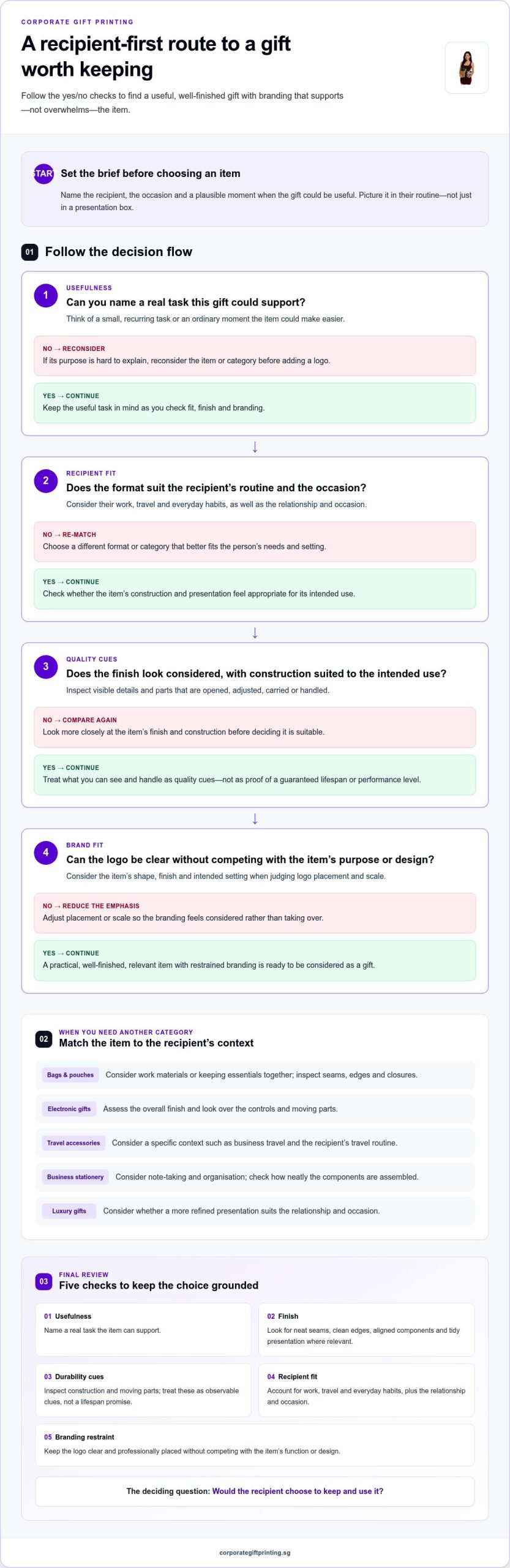
Before settling on an idea, ask: Would the recipient choose to keep and use this item? Picture it in their routine, not just in a presentation box. If you can’t name a plausible moment when it would be useful, reconsider the category or the item’s quality before adding a logo.
- Does it help with a small, recurring task?
- Does its size and format suit the recipient’s routine?
- Does its finish feel appropriate for the relationship?
- Will the branding still feel considered after the gift is unwrapped?
The recipient-first test for a corporate gift
Start with a familiar task the recipient might repeat: carrying work materials, keeping essentials together, travelling for business or organising notes. The gift doesn’t need to solve a major problem. It should make an ordinary moment a little easier. Then consider the relationship and occasion. A straightforward, practical item may suit a broad employee group, while a more refined presentation may better reflect an important client relationship.
Novelty can prompt an initial reaction, but surprise alone doesn’t make an item useful or thoughtful. A quirky object without a clear purpose may quickly lose its appeal. A familiar, practical choice selected with the recipient’s habits in mind can feel more personal because it shows attention to what they might actually use.
When branding adds value, and when it gets in the way
Branding can help recipients remember the company behind an item, especially when the gift becomes part of their routine. But visibility works best when the item is worth using in the first place. Consider its shape, finish and intended setting, then choose a logo placement and scale that sit naturally within the design.
A considered brand detail is clear without competing with the item’s purpose. An oversized mark or repeated logo treatment can turn a useful gift into an advertisement the recipient may not want to carry or display. Restraint keeps the balance right: the gift serves the recipient, while professional printing connects it to your brand without taking over.
How to judge quality, usefulness, and brand fit before choosing
A promising idea needs a closer look before it becomes a gift. Apply the same five checks to each option so your decision accounts for what the recipient will use and how well the item represents your company, not just how it looks.
- Usefulness: Name a real task the item can support. If its purpose is hard to explain, it may not earn a place in the recipient’s routine.
- Finish: Where relevant, look for neat seams, clean edges, aligned components and a tidy overall presentation.
- Durability cues: Inspect construction and moving parts, such as closures, hinges or controls. These are observable clues, not proof of a particular lifespan.
- Recipient fit: Consider the person’s work, travel and everyday habits, as well as the relationship and occasion.
- Branding restraint: Check that the logo is clear and professionally placed without competing with the item’s function or design.
How often someone is likely to use a gift should influence its category and construction. An item intended for frequent handling deserves particular attention to its finish and the parts that are opened, adjusted or carried. A gift for occasional use can be selected for a specific context, such as business travel, rather than daily convenience. In either case, judge the item against the intended use, not an assumed performance claim.
Which quality cues can buyers assess?
Inspect the item as the recipient would encounter it. For a bag or pouch, examine the seams, edges and closure. For an electronic gift, look over its controls and overall finish. For stationery, check how neatly its components are assembled. Ask whether the item feels appropriate for regular or occasional use. These signs help you compare options, but they don’t establish a guaranteed lifespan or performance level.
Keep the distinction clear: what you can see and handle is evidence of presentation and construction, not a promise about how long an item will last. Avoid claims about longevity unless reliable product information supports them. A measured assessment protects the recipient’s experience and your brand’s credibility.
Does the gift suit the recipient and your brand?
Match the format to the recipient’s routine. Someone who travels for work may appreciate a different item from someone whose day centres on meetings and note-taking. Then consider the level of formality. A gift for a close working partner may call for a different presentation from one intended for a wider employee group. Choose a style that fits the relationship, not just one that seems novel.
Finally, view the item and logo together. The placement should make the company recognisable while preserving the item’s appeal and practical use. Corporate gifts that aren’t junk balance recipient fit, visible quality and a brand detail that feels intentional.
Explore customised corporate gift categories to compare bags and pouches, electronics, travel accessories, business stationery and luxury gifts for your gifting goal.
Which corporate gift categories are useful rather than disposable?
No category is automatically a good choice. The right fit depends on who will receive the gift, how they might use it and what the occasion calls for. Use this comparison to narrow your options, then assess the specific item and branding against your brief.
| Category | Recipient | Everyday use | Branding opportunity | Potential drawback |
|---|---|---|---|---|
| Bags and pouches | People who carry work or personal essentials | Can support commuting, meetings or daily organisation | A logo can be placed where it’s visible during regular use | A size or format that doesn’t suit the recipient may go unused |
| Electronic gifts | Recipients who can use the item in their work or routine | May support a practical task, depending on the item | Branding can connect the item with your company while keeping controls and use clear | Unclear specifications or a poor match to the recipient’s needs can undermine usefulness |
| Travel accessories | People whose work or lifestyle involves travel | Can help organise items or support a travel routine | A discreet mark can keep your brand associated with the item’s use | Recipients who rarely travel may have little reason to use them |
| Business stationery | People who take notes or organise desk work | Can be useful during meetings and everyday planning | Logo placement can be visible without dominating the working surface | It may be less relevant to recipients who rely on digital tools |
| Luxury gifts | Recipients and relationships suited to an elevated gesture | Use depends on the item and the recipient’s preferences | Refined branding can support a polished presentation | A formal or elaborate choice may feel out of place for a casual occasion |
When do bags, travel accessories, and stationery make sense?
Choose bags and pouches when carrying or organising essentials is part of the recipient’s routine. Travel accessories are a closer fit for people who travel regularly for work. Otherwise, their specific purpose may limit use. Business stationery can suit recipients who write notes or manage paper documents. For more detail on stationery options, explore our guide to business stationery.
When are electronic or luxury corporate gifts a better fit?
Electronic gifts work best when the function is relevant, straightforward to use and supported by clear, credible specifications. Luxury gifts may suit a milestone or important relationship where a more elevated gesture feels appropriate. The category alone doesn’t determine value: consider the recipient’s preferences, the occasion and whether the item will be welcomed. Our luxury corporate gifts guide explores that category in more detail.
Think of this comparison as a starting point, not a universal ranking. A useful item for one recipient may be irrelevant to another. The strongest corporate gifts that aren’t junk fit the audience and purpose, with branding that complements the item rather than dictating the choice.
A practical checklist for choosing a corporate gift recipients will keep
A clear process keeps a gift decision grounded in the recipient’s needs, even when several options look appealing. Set practical requirements first, then choose a category and decide how your branding should appear. This stops a striking design or prominent logo from taking priority over the gift’s purpose.
A stronger gift choice starts with recipient fit and everyday function, then uses branding to make the item a considered expression of your company.
- Define the purpose. Decide what the gift should communicate, such as appreciation, recognition or a welcome. A clear purpose gives you a useful filter and helps the final choice suit the occasion.
- Identify the audience. Note who will receive it and what relationship the gift represents. A gift for employees, clients or business partners may call for different levels of formality and presentation.
- Describe the use case. Think about the recipient’s likely work, travel or everyday routine. State the function the item should serve and any requirements that would make it easier to use or carry.
- Select the category. With the audience and use case in view, compare relevant options such as bags and pouches, electronic gifts, travel accessories, business stationery or luxury gifts. Prioritise usefulness over appearance.
- Set the branding direction. Record how the company identity should appear, including preferences for logo scale, placement, colour clarity and presentation. Treat branding as a finishing decision, not a substitute for a suitable item.
Build a clear gift brief before comparing options
A useful brief captures the recipient, the relationship or occasion, the likely routine and the job the gift should do. Add practical requirements, brand guidance and any presentation or distribution considerations relevant to the project. These details give you a consistent basis for comparing ideas while leaving room to tailor the sourced item and customisation to your goal.
Review the shortlisted gift before approving it
Before approval, return to the original brief. Does the item suit the audience and serve the intended function, or is its appeal mainly novelty? Review the artwork against the item itself. Check that the logo is legible at its chosen scale, sits in an appropriate position and stands out against the background. Make sure the colours and overall treatment align with your brand identity.
Then consider the complete impression, including how the item and its presentation work together. The selection should feel professional for the occasion and natural for its intended audience. If the branding reduces readability or distracts from the item, refine the treatment before proceeding.
See how custom sourcing and professional logo printing can bring a recipient-led gift brief to life.
How Corporate Gift Printing turns a thoughtful gift idea into a branded item
A considered gift starts with a clear idea of who it’s for and what it should do. Corporate Gift Printing connects that recipient-led brief to a suitable item, then customises and prints company branding so the finished gift reflects the recipient’s needs and the company’s identity. This sourcing and printing service helps turn a gifting intention into a tangible, professionally presented item.
From gifting objective to a suitable item
The recipient, occasion and intended use guide the category. A brief for practical work essentials points in a different direction from one for frequent travellers or an important business relationship. There isn’t one category that suits every audience. The right choice depends on how the gift fits the people receiving it and the purpose behind it.
- Bags and pouches may suit a brief centred on carrying or organising everyday essentials.
- Electronic gifts can fit a practical need when the item’s function is relevant and its specifications are clear.
- Travel accessories may suit recipients whose routines involve business travel.
- Business stationery can suit a work context that involves note-taking or organising written materials.
- Luxury gifts may support a more elevated gesture for an occasion or relationship that calls for one.
These are starting points, not automatic recommendations. A travel accessory may be a poor match for someone who rarely travels, just as stationery may not suit a recipient whose work is primarily digital. A clear brief helps Corporate Gift Printing source an item aligned with the intended use, rather than selecting a category simply because it’s familiar.
From selected item to professional brand presentation
Once the item is selected, logo printing makes it recognisable as a corporate gift and connects it with your company. The mark should be clear and legible, proportionate to the item, and positioned to work with its design. Professional branding completes the gift; it shouldn’t distract from the reason someone would use it.
Share the details that shape the decision: the audience, occasion, intended function and impression your company wants to convey. Brand identity matters, but so do the item’s form and use. Considered customisation brings those elements together, giving the logo a purposeful place without making the gift feel like an advertisement first.
That is the practical path to corporate gifts that aren’t junk: clarify the goal, source an item that fits and finish it with considered branding. Whether your brief points to bags and pouches, electronics, travel accessories, business stationery or a luxury gift, Corporate Gift Printing can help turn the idea into a branded physical item.
Ready to shape your idea into a considered corporate gift? Discuss your corporate gifting brief and take the next step from recipient needs to a professionally branded item.
Make your next gifting decision more intentional
A thoughtful corporate gift can help mark a meaningful moment in a business relationship. Think ahead about the occasions your team wants to recognise and the impression you hope recipients carry with them. Planning with the audience in mind makes gifting feel less like a last-minute task and more like a sincere extension of how your company works with people.
Use corporate gifts that aren’t junk as a standard for future decisions: choose with care, keep the recipient in view and let the finished gift express your brand with confidence. Corporate Gift Printing sources and customises bags, electronics, travel accessories, business stationery and luxury gifts with company logos.
Explore customised corporate gifts for your next thoughtful gesture and take the next step towards a gift your recipients can genuinely appreciate.
Frequently Asked Questions
What makes a corporate gift feel like junk?
A corporate gift can feel like junk if it has no clear place in the recipient’s life. Clues include items left unopened, awkward to store or difficult to use without extra effort. A gift may also miss the mark if recipients already have several similar items or if it feels disconnected from the occasion. Before choosing, picture where the item would go after it’s unwrapped and what might prompt the recipient to reach for it.
Are branded corporate gifts still effective?
Yes, branded gifts can support recognition when recipients have a reason to keep the item nearby or use it. Think about the context in which the logo will be seen, such as a work setting, commute or business trip. The mark doesn’t need to dominate to connect the gift with your organisation. For corporate gifts that aren’t junk, choose an item that earns continued use first, then let the branding reinforce that association.
How do I choose a corporate gift that employees or clients will use?
Separate what the recipient group actually does from what you assume they do. For a mixed employee group, consider whether the same item would serve people with different roles and routines. For a specific client, think about the context in which you work together. Informal feedback from colleagues who understand the audience can reveal practical preferences and help you avoid choosing an item based only on internal enthusiasm.
Are useful corporate gifts better than novelty giveaways?
Useful gifts are often a sound choice when you want the gesture to remain relevant beyond the moment of presentation. Novelty can still work if it connects naturally to the occasion or gives recipients a shared point of enjoyment. Be clear about the goal: a brief promotional interaction may call for a different approach from recognising a valued relationship. Choose novelty for a reason, not simply because it stands out.
What should I consider before putting a company logo on a gift?
Consider how the logo will look on the actual item, not only in a digital artwork file. A mark that seems balanced on screen may compete with a seam, control or other visual feature once printed. Review its scale and position in relation to the item’s shape, and consider whether a slogan or additional message is necessary. An uncluttered treatment can help the gift feel polished and make the company identity easier to recognise.
Which corporate gift categories are most practical?
Practicality depends on the recipients and the context in which they might use the gift. Bags and pouches may suit people who carry work essentials; travel accessories make more sense for people who travel; stationery can fit note-taking habits; and electronic gifts should serve a clear purpose. Luxury gifts may suit a more formal gesture. For a group with varied routines, prioritise broad relevance over choosing a category simply because it’s popular.