A corporate gift earns its place when it advances a clear business goal, not simply because it was delivered. For measuring ROI of corporate gifting, calculate (revenue preserved plus new revenue minus gifting cost) ÷ gifting cost × 100. The right result depends on what the programme is designed to achieve, such as stronger client retention, employee satisfaction or referrals.
It’s natural to want a clear return from every campaign, but corporate gifts can also strengthen relationships in ways that take time to show. To measure the ROI of corporate gifting, identify the costs to include, set a baseline before sending gifts and connect campaign activity to outcomes. Track responses, renewals and other relevant indicators to assess both financial returns and relationship value.
Key Takeaways
- Choose one primary business outcome, then use a small set of relevant measures to judge whether the gifting programme supports it.
- Build a complete cost picture by accounting for the gift, customization, packaging, delivery and staff time.
- Record response, purchase, renewal or engagement results before the campaign so you can compare them with what happens afterward.
- Pair financial calculations with relationship indicators, such as client feedback and retention, to understand value that revenue alone may not capture.
What is a good ROI for a corporate gifting program?
There is no universal benchmark for a good return. Results depend on the campaign’s goal, audience and gift value. Measure financial outcomes alongside relationship indicators, and compare them with a clear baseline.
-
Define Financial and Intangible Benefits
Choose one primary outcome, such as new revenue, client retention or employee satisfaction. For financial results, count incremental revenue and preserved revenue only when the evidence supports a reasonable connection to the campaign. For relationship value, track recipient feedback, referrals, repeat purchases or Net Promoter Score. These indicators can inform your assessment, but don’t assign them invented dollar values.
Benchmarks vary by industry and campaign because audiences, gift values and intended actions differ. A claim-based campaign might track redemptions, while client appreciation may focus on retention. Compare gifting with other marketing channels only when the goal, attribution rules, cost categories and measurement window are consistent. Otherwise, the outcomes may not be directly comparable.
-
Apply the ROI Formula
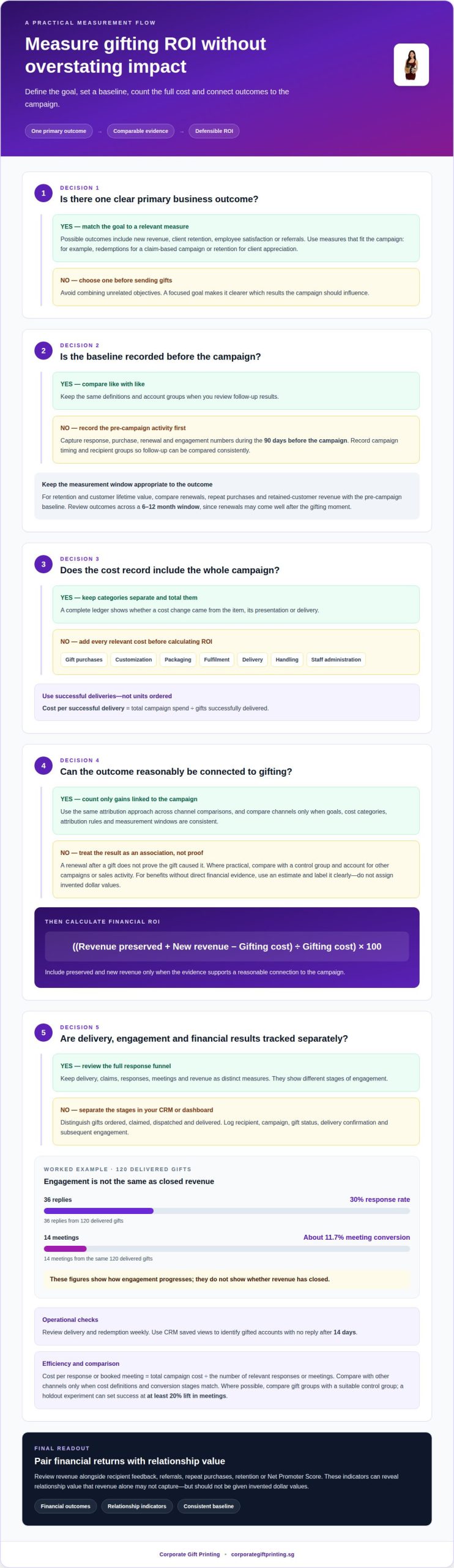
Calculate ROI by adding revenue preserved and new revenue, subtracting total gifting cost, dividing by that cost, then multiplying by 100. For example, the formula is: ((revenue preserved + new revenue − gifting cost) ÷ gifting cost) × 100. Include only gains linked to the campaign, and use the same attribution approach for every channel comparison.
Track the response funnel as well as the financial result. In a worked example, 36 replies from 120 delivered gifts produce a 30 per cent response rate; 14 meetings from those 120 gifts produce roughly an 11.7 per cent meeting conversion rate. These figures show where engagement progresses, not whether revenue has closed.
-
Assess Payback and Cost Efficiency
Measure payback by tracking when accumulated attributable contribution covers the campaign’s total cost. To calculate cost per response or booked meeting, divide total campaign cost by the number of relevant responses or meetings. Compare these figures with other channels only when cost definitions and conversion stages match.
To assess long-term effects on retention and customer lifetime value, compare renewal rates, repeat purchases and retained-customer revenue with the pre-campaign baseline. Review outcomes across a 6-12 month window, since renewals may follow well after the gifting moment. Record campaign timing and recipient groups so stronger retention isn’t mistaken for an effect without a meaningful comparison.
Tracking gift, customization, packaging and delivery costs
Build the campaign around one outcome, a complete cost record and clear delivery tracking. This makes it easier to connect gifting activity with measurable results.
- Build a full cost ledger. Record gift purchases, customization, packaging, fulfilment, delivery, handling and staff administration. Keep each category separate, then total it for the campaign. This shows whether a cost change came from the item, its presentation or getting it to the intended recipient.
- Calculate cost per successful delivery. Divide the total campaign spend by gifts successfully delivered, not units ordered.
- Set the baseline and CRM fields before sending. Record existing response, meeting and purchase activity for the intended accounts. In the CRM, log recipient, campaign, gift status, delivery confirmation and subsequent engagement. This makes it easier to connect outcomes to the campaign and compare activity against the baseline.
- Track claims and delivery stages. Distinguish gifts ordered, claimed, dispatched and delivered; these are different measures. Use CRM saved views to identify gifted accounts with no reply after 14 days. Review delivery and redemption weekly, so failed delivery or low engagement can inform the next decision.
- Use a dashboard to evaluate impact. Bring cost, delivery, claims, responses and meetings into one view. Compare gift groups with a suitable control group where possible; a holdout experiment can set success at at least 20% lift in meetings. Track relationship outcomes alongside campaign activity, then use the combined evidence to refine future planning.
Establishing baselines and avoiding measurement pitfalls
Set your measurement plan before sending gifts. A consistent baseline lets you compare campaign outcomes with earlier activity.
-
Define Campaign Objectives and Baselines
Choose one specific business objective, then connect it to measurable metrics. For example, set a goal to increase customer retention by 15% over six months through gifts to high-value clients after their first purchase. Select supporting indicators that reflect this goal, such as renewals, repeat purchases or satisfaction feedback. Avoid combining unrelated objectives, because a busy dashboard can obscure the decision the campaign should inform.
-
Collect Baseline and Follow-Up Data
Record response, purchase, renewal and engagement numbers during the 90 days before the campaign. Use the same definitions and account groups when collecting follow-up data, so the comparison remains consistent. Then track outcomes after delivery at planned intervals, noting campaign timing and any changes in recipient activity. A CRM or spreadsheet can hold the records, while a dashboard makes movement across selected metrics easier to review.
-
Avoid Measurement Pitfalls
Separate correlation from attribution: a renewal after a gift doesn’t prove the gift caused it. Where practical, compare results with a control group, and account for other campaigns or sales activity that could influence outcomes. Use the same measurement window across recipients, since different follow-up timing can distort comparisons. Keep the dashboard focused on three to five supporting KPIs. For benefits without direct financial evidence, use an estimate and label it clearly rather than presenting it as confirmed revenue.
Review numeric results alongside recipient feedback. If retention improves but response numbers don’t, investigate whether the gift helped strengthen existing relationships rather than prompt immediate action. Record what you learn against the baseline so you can refine the audience, timing and objective of the next campaign.
Corporate gifting ROI formula and definitions
Use consistent definitions to connect campaign spending with attributable financial outcomes. Clear calculations help teams interpret results and compare campaigns fairly.
- Define what counts as a return. Include new revenue and revenue preserved through renewals, but count each gain once. For employee gifting, choose a relevant target, such as retention or engagement. Don’t treat positive feedback as revenue. Track qualitative outcomes separately, or label any financial estimate clearly. A disciplined approach to measuring ROI of corporate gifting keeps these distinctions visible.
- Apply the formula consistently. Calculate: ((revenue preserved + new revenue − total gifting cost) ÷ total gifting cost) × 100. This gives the percentage return on programme cost. For example, a campaign generating S$40,000 in revenue with S$20,000 in costs produces 100% ROI. That means net return equals the original cost, not that revenue doubled. Use the same calculation when measuring ROI of corporate gifting across campaigns.
- Keep revenue and profit distinct. Revenue and profit describe different financial outcomes, so clarify which measure you use. If a decision depends on profitability, apply the business’s usual contribution-margin approach consistently. Avoid comparing a revenue-based gifting result with another platform’s profit-based result, since their efficiency measures differ.
- Document attribution and timing. Record which recipients received gifts, what action followed and when it occurred. For renewals, connect the account and contract outcome to the campaign record; don’t credit a gift for unrelated sales activity. Review results at consistent intervals and state whether figures represent observed revenue or an estimate. This makes the calculation useful for the next budget decision.
For a campaign built around a defined target, plan corporate gifts for your campaign with the intended recipients and outcome in mind.
Corporate Gift Printing
Corporate Gift Printing helps businesses turn gifting objectives into branded gifts suited to their recipients and campaign goals. Whether you’re strengthening client relationships or recognising employees, a thoughtfully selected gift can feel relevant and reinforce a consistent brand impression.
Choose from Customized Bags & Pouches, Electronic Corporate Gifts, Travel Accessories and Business Stationeries. Once you’ve defined the campaign audience, purpose and budget, Corporate Gift Printing can help bring the gift selection and branding together. Record the selected items and campaign costs in your tracking process, then compare results with your baseline.
When presentation and recipient experience matter, align the gift with the occasion and the relationship you want to build. Contact Corporate Gift Printing to discuss your corporate gifting requirements.
Give your next campaign a clear purpose
Before choosing a gift, decide what you want recipients to feel, remember or do next. That intention can guide the occasion, message and follow-up, creating a more coherent experience for both your audience and your team. A thoughtful approach to measuring the ROI of corporate gifting keeps the focus on valuable business relationships, not simply sending more items.
Corporate Gift Printing offers Customized Bags & Pouches, Electronic Corporate Gifts and Travel Accessories for businesses planning branded gifting. Start with your audience and the impression you want to leave, then translate that goal into a considered gift choice.
When you’re ready to shape a corporate gifting campaign around your business objectives, contact Corporate Gift Printing. Take the next step with a clear purpose and create a gesture that feels personal, professional and true to your brand.
Frequently Asked Questions
Can a Gift Be Credited for a Client Renewal?
Attribute a renewal to gifting only when the account history supports a plausible connection. Compare gifted clients with similar clients who did not receive gifts, and note other sales or service activity that could have influenced renewal. For example, if a client renews after receiving a gift and completing a contract review, report the renewal as associated with the campaign unless your attribution method can separate the effects.
How do you connect gifting to revenue?
Link each recipient or account to a campaign record, then follow the sequence from gift delivery to response, opportunity and closed revenue. Use a consistent attribution rule if several sales touches contributed. For a multi-touch journey, a position-based model can assign 40% to the first touch, 20% to middle touches and 40% to the final touch. Label attributed revenue clearly.
How do you prove ROI to leadership?
Present a concise, decision-focused report covering the campaign objective, total investment, attributed financial result and supporting engagement evidence. Show the calculation and its assumptions, including which opportunities counted and how revenue was attributed. Add a recipient comment or account example to put relationship outcomes in context. Finish with a clear recommendation to repeat, adjust or pause the campaign based on the evidence.
How do you set the baseline?
Choose the recipient group and metrics before the campaign, then pull comparable historical data from the same CRM fields. Select measures that match the objective, such as renewal status for a retention campaign or meeting activity for prospect outreach. Record the extraction date and metric definitions so reviewers can distinguish genuine changes from differences in reporting practices or audience.
Should Unused Gifts Count in ROI?
Include purchased gifts in campaign spending, even if some remain unclaimed or undelivered. Leaving them out understates the campaign’s actual cost. Track unused stock separately from gifts received, and don’t count inventory as recipient engagement. For example, report units purchased, successful deliveries and remaining stock as separate figures, then apply the same cost treatment when comparing future campaigns.
What costs should you include?
Include the gifts, customisation, packaging, fulfilment, delivery, handling and staff time spent on planning or administration. Add relevant platform or software expenses when they support campaign management. Keep cost categories separate so leadership can see what drove spending and compare campaigns consistently. Include costs for failed deliveries or replacements when incurred, rather than reporting only successful sends.