The cost of full color logo printing on gifts depends on more than the number of colours. The printing method, print area, order quantity, logo design and gift surface all affect the project. Corporate Gift Printing provides pricing after you request a quote.
It’s understandable to expect a full-colour logo to call for one standard printing method, but the right choice can change with the gift. A detailed gradient on a smooth item presents different needs from a simple mark on fabric, and the recipient and intended use matter too. This guide explains what drives printing costs and how to compare decoration methods against your logo, the gift’s surface, quantity and timing. You’ll also see why a method that suits one item may not create the clearest, most considered result on another, helping you make a more informed choice for business gifts in Singapore.
Key Takeaways
- Assess logo placement against the gift’s shape and construction so the finished mark looks balanced and stays clear of seams or stress points.
- Use a design proof or physical sample to evaluate colour, sharpness, size and position before production begins.
- Match the decoration method to the logo’s detail and the material, since a technique that works well on one surface may not suit another.
- Consider how recipients will use the gift and when it’s needed to guide choices around finish, quantity and production planning.
How does a professional choose the best printing method for a logo on corporate gifts?
Start by matching the logo placement to the gift’s shape, material and intended presentation. A broad, flat panel on a canvas tote can give the logo room to read, while seams, zippers and folds on a pouch can interrupt the image or expose it to more wear. For full-colour branding, check whether the design crosses handles, joins or curved edges. A balanced placement keeps the printed area clear of points of strain.
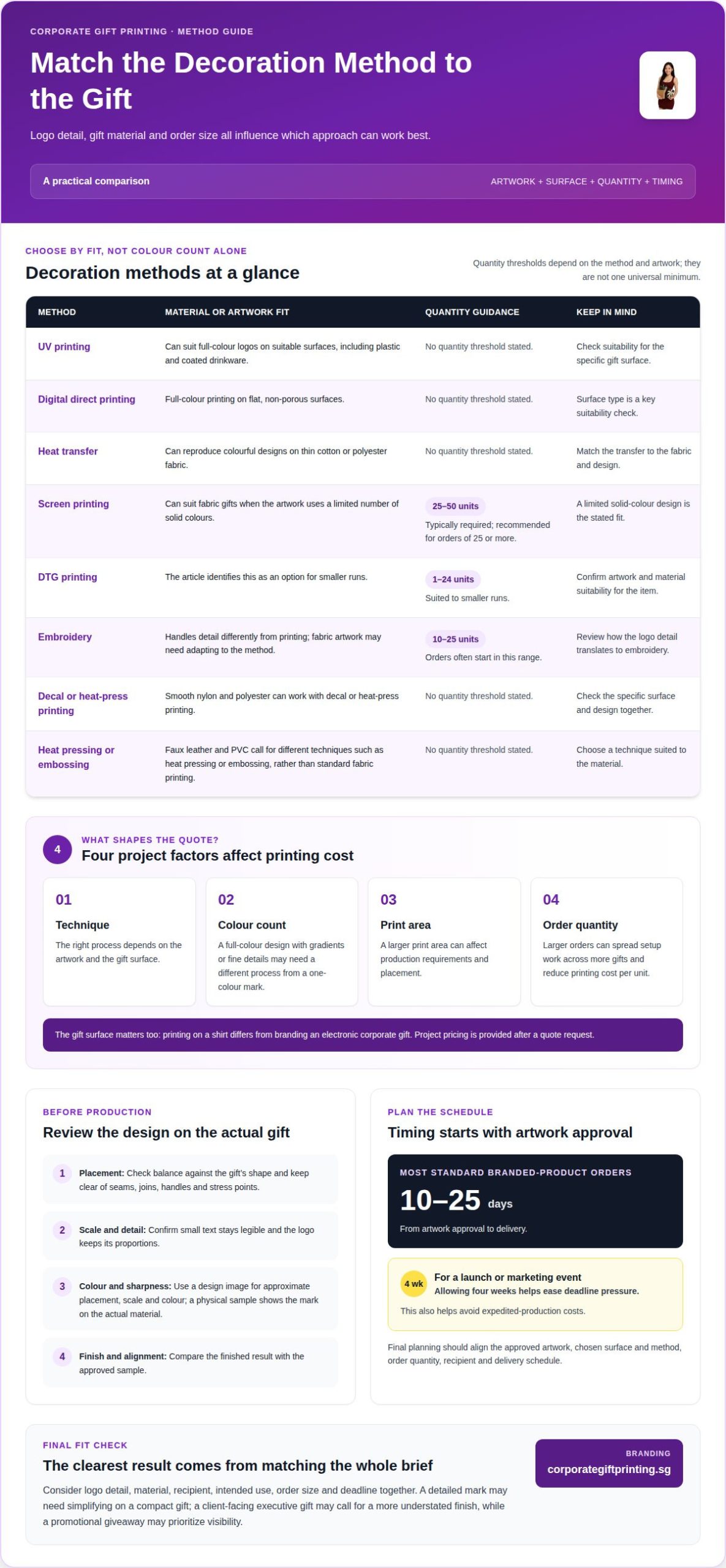
Logo proportions matter as much as placement. A detailed mark may need simplifying for a small gift, while a wide logo can look distorted on a narrow surface. Possible full-colour methods include UV printing on suitable surfaces, digital direct printing on flat, non-porous surfaces and heat transfer for colourful designs. Screen printing can suit fabric gifts when the artwork uses a limited number of solid colours. Match the artwork and material rather than choosing a method by colour count alone.
Before a production run, the supplier can provide a design image and physical sample for review. On the sample, assess colour accuracy, sharpness, print size and alignment on the actual product. A supplier managing production with commercial printers coordinates artwork preparation, print placement, production settings and finishing, then checks the finished result against the approved sample. For Singapore projects, product-specific compliance and print quality are separate considerations: the gift’s requirements depend on its type and use, while sample review assesses the branding.
Care guidance should suit the decoration and the gift. Printed fabric items may be hand-washed or washed on a gentle machine cycle; avoid washing them alongside rough items or garments with zippers. Prolonged direct sunlight can make some inks brittle and more likely to crack. Clear care instructions help recipients preserve the printed finish, especially on useful promotional gifts intended for repeated use.
2. What determines the cost of logo printing?
The cost of logo printing depends on the technique, colour count, print area and order quantity. A full-colour design with gradients or fine details may need a different process from a one-colour mark. A larger print area can affect production requirements, while larger orders can spread setup work across more gifts and reduce the printing cost per unit. The surface matters too: printing on a shirt differs from branding an electronic corporate gift.
Artwork review helps clarify these choices before production. A digital design image can show approximate placement, scale and colour; a physical sample shows how the mark appears on the actual material. Check whether small text remains legible, colours look distinct and the design keeps its proportions. Fine details that look clear on screen may become crowded on a compact gift. Embroidery handles detail differently from printing, so fabric artwork may need adapting to the chosen method.
To compare quotations meaningfully, keep the gift, artwork, print area and quantity consistent across options. Price depends on the project and is provided after a quote request; the technique, colour count, print area and quantity are key cost factors. For a corporate gift where presentation matters as much as the item, explore branded gift options and consider how the packaging and decoration will feel to recipients. A clear brief helps align the intended impression with the production approach.
3. Choosing a method based on logo, recipient, surface, use, quantity and timing
Consider the logo, gift material, recipient, intended use, order size and deadline together. A detailed, gradient-heavy mark needs different treatment from a simple solid logo, while simplifying artwork can help preserve legibility on a compact item. A client-facing executive gift may call for a more understated finish; a promotional giveaway may prioritize visibility. The right recommendation balances brand impression with the way recipients will use the gift.
Full-colour logos can be digitally direct-printed on suitable flat, non-porous surfaces. UV printing suits surfaces such as plastic and coated drinkware, while heat transfer can reproduce colourful designs on thin cotton or polyester fabric. Cotton and canvas may also suit screen printing or transfer methods, depending on the design. Smooth nylon and polyester can work with decal or heat-press printing. Faux leather and PVC call for different techniques, such as heat pressing or embossing, rather than standard fabric printing.
Minimum quantities depend on the method and artwork. Screen printing is recommended for orders of 25 units or more with a limited number of solid colours, and typically requires a minimum of 25 to 50 units. DTG printing suits smaller runs of 1 to 24 units, while embroidery orders often start at 10 to 25 units. These method-specific thresholds help shape the recommendation; they aren’t one universal minimum for every custom gift.
Timing starts with artwork approval. Most standard branded-product orders need 10 to 25 days from artwork approval to delivery. For an important launch or marketing event, allowing four weeks helps ease deadline pressure and avoid expedited-production costs. A professional aligns the chosen surface and method with the recipient, quantity and schedule, then plans production around the approved artwork. This approach helps ensure the gift’s finish suits its purpose and arrives in time for its intended use.
4. Comparing logo printing and decoration techniques
UV printing suits multi-colour or gradient logos on surfaces such as plastic and coated drinkware. Digital direct printing works for full-colour designs on flat, non-porous surfaces. Heat transfer can reproduce sharp, colourful artwork, especially on thin cotton or polyester fabric. Sublimation may suit compatible items, depending on the gift surface. A sample helps you see how colour and detail appear on the chosen material.
For fabric gifts, screen printing produces bold colour and can suit larger runs with a limited number of solid colours. It is less suited to logos with many colours. Embroidery adds texture to fabric, including caps and selected apparel, and can handle single- or multi-colour logos, although intricate artwork may need simplifying. Laser engraving offers a different finish on metal or wood-based gifts, creating a subtle, durable mark rather than a printed colour image.
Use the logo’s appearance and the recipient’s likely use to guide the choice. A vivid gradient on coated drinkware points toward UV printing; a clean, few-colour design across a larger fabric order may suit screen printing. A simple mark on a metal gift may look more considered when engraved. These printing methods affect finish, detail and suitability, not just production. Browse custom corporate gift options and match the decoration to the item’s surface before finalizing the choice.
Corporate Gift Printing
Corporate Gift Printing helps businesses turn a selected item into a considered brand touchpoint by sourcing, customizing and printing company logos on corporate gifts. It’s a natural next step when you’ve chosen an item and want its branding to suit the surface, design and recipient. Options include Customized Bags & Pouches, Electronic Corporate Gifts, Travel Accessories and Business Stationeries, so you can match the gift category to its purpose.
Share the gift you have in mind, your logo artwork, intended quantity and timing to help shape a suitable item and branding approach. Corporate Gift Printing creates branded gifts for clients, partners and employees. For a more considered gesture, Luxury Corporate Gifts are another option.
Contact Corporate Gift Printing to discuss your branded gift requirements.
Shape a branded gift around the relationship
A thoughtful corporate gift can carry your brand into a client meeting, a partner’s daily routine or an employee’s next journey. Treat full color logo printing on gifts as part of the gesture: the item and its presentation should feel appropriate to the recipient, not simply display a logo. Choosing with the recipient and occasion in mind helps make the gift feel relevant and considered.
Corporate Gift Printing can bring that intention to life with Customized Bags & Pouches, Electronic Corporate Gifts and Travel Accessories. Start with the role the gift should play, then share the audience, preferred item, artwork and timing. These details help align the branding with the gift’s purpose.
Whether you’re preparing a client thank-you or welcoming new partners, a well-chosen branded gift can make the interaction more personal. Contact Corporate Gift Printing to discuss your project and take the next step towards a gift that reflects your business with care.
Frequently Asked Questions
What determines the cost of logo printing?
The printing technique, logo colours, print area and order quantity all affect cost. A design with gradients may require a different process from a simple solid mark, while different gift types can involve distinct production setups. For a useful comparison, keep the artwork, quantity and placement consistent between options. Then consider whether the finish suits the gift’s purpose and the impression you want recipients to remember.
What is the best printing method for a logo on corporate gifts?
The best method depends on the artwork and the gift’s surface, so there is no universal choice. A simple solid logo on a larger fabric order may suit screen printing, while a detailed, colourful design may call for UV printing or heat transfer on compatible items. For a metal gift, laser engraving can create a different, understated finish. The recipient and the way they will use the item help guide the choice.
What file format do I need for logo printing?
Vector artwork is preferred, with AI, EPS, SVG and PDF among the suitable formats. Because vector artwork scales without losing quality, it can adapt to different print sizes while preserving clean edges. If you only have a raster image, its resolution should generally be at least 300 DPI at the intended print size. Supplying the logo in its intended proportions also helps prevent unwanted stretching during production.
How much does full-color logo printing on gifts cost in Singapore?
The cost of full color logo printing on gifts depends on the project and is provided after a quote request. Key factors include the decoration technique, the number of logo colours, print area and order quantity. The gift’s material and the artwork’s complexity also shape the suitable production approach. To support a clear quotation, specify the item, quantity, preferred placement and intended use for your Singapore order.
What artwork file formats, resolution, and color profiles are required for full-color printing?
Send vector artwork in AI, EPS, SVG or PDF where possible; raster artwork should generally be at least 300 DPI at its intended print size. Include brand colour references, such as PANTONE codes, so the intended shades are clear. There isn’t one colour-profile specification that applies to every printing method and material. A proof or sample provides a practical way to assess how the colours appear on the chosen gift.
How durable and colorfast is full-color printing on different gift materials?
Durability varies by method, material and care. Screen-printed and DTG-printed logos can remain in good condition for 50 or more washes with proper care, while embroidery can survive hundreds of washes. Direct sun exposure can make some inks brittle over time, and screen printing on smooth polyester may peel after a few washes or uses. Follow suitable care instructions to help preserve the decoration.