Everyday office essentials can do more than keep work moving. Office supplies branding in Singapore can give business stationery, copier paper, writing materials and pens a consistent company identity, with each item chosen for its purpose. Business cards, invoices and official documents also shape the impression clients and partners form of your company.
Prioritise practical details: paper should suit your printing tasks, while pens and notepads should work well for the people using them. When these choices are coordinated, branded supplies can support a polished, consistent workplace identity.
This guide explains how to choose stationery and writing materials for different workplace needs, what to consider when selecting paper and pens, and how branding affects the finished result. It also outlines what to include in a project brief so your requirements, budget and timeline are clear.
Key Takeaways
- Choose stationery for the impression it creates as well as its everyday purpose, from client-facing documents to internal notes.
- Match copier paper and writing materials to how your team prints, writes and shares information.
- Compare pen materials, writing feel and branding placement; some sustainable pens are made from 91% recycled materials.
- Custom order quantities can vary by item and project, so plan around your intended use, budget and timeline.
- Production and delivery planning depends on the product, customisation and order requirements; a clear brief helps align the process.
Office stationery and supplies
Business cards, invoices and official documents shape clients’ and partners’ impressions. For office supplies branding in Singapore, match each item to its daily use and intended audience.
For wholesale office and stationery supplies, group products by purpose. Separate client-facing documents from internal-use items, then coordinate quantities and branding within each group.
Branded Stationery and Kits
Branded stationery can bring business cards, notepads, folders and writing materials together as a consistent set. A meeting kit, for example, could pair a branded notepad with a pen and document folder. Choose items based on where they will be used, who will receive them and whether staff need replacements for routine work.
Office stationery for businesses should balance presentation and everyday function. Consider paper products alongside the documents printed on them, such as invoices and official letters. A coordinated set can create a considered impression in client meetings, while internal supplies can prioritise clear identification and practical use.
Printing and Branding Methods
Printing methods depend on the material, surface and artwork. Digital printing suits many paper items, including business cards and notepads. Screen or pad printing may suit some hard surfaces, while foil stamping can add a distinctive finish to suitable stationery. Compare the logo detail, colour requirements and available print area before choosing.
Match the printing method to each item. Fine text and small logo details may need a different approach from a simple, single-colour mark. A paper folder and a pen have different surfaces, so the same printing method may not suit both.
Artwork, Colors, and Pre-Order Checks
Prepare a clean, high-resolution logo file and provide the correct business name, contact details and approved artwork. Choose colours that remain clear against the selected paper or product. Before approving production, review a proof for spelling, alignment, logo size and legibility at its final scale.
Before ordering, confirm the item list, quantities, packaging needs, delivery address and required timeline. Singapore’s Intellectual Property Office explains that registering a business name with ACRA does not provide trade mark protection. Make sure your business has approval to use the artwork.
Are there GST, shipping, or setup fees for branded office-supply orders in Singapore? These charges depend on the order and should be stated in its quotation. The total is provided after a quote request, with the item, quantity, branding method and delivery requirements affecting the cost.
What should businesses check before ordering branded office supplies in Singapore? Confirm the item specifications, artwork proof, quantities, branding method, delivery details and any charges in the quotation. This review helps ensure wholesale office and paper products suit your workplace needs.
For routine desk replenishment, MAX No.B8 staples are sold in a box of 5000, making pack size a practical detail to check alongside other supplies.
Copier paper and writing materials
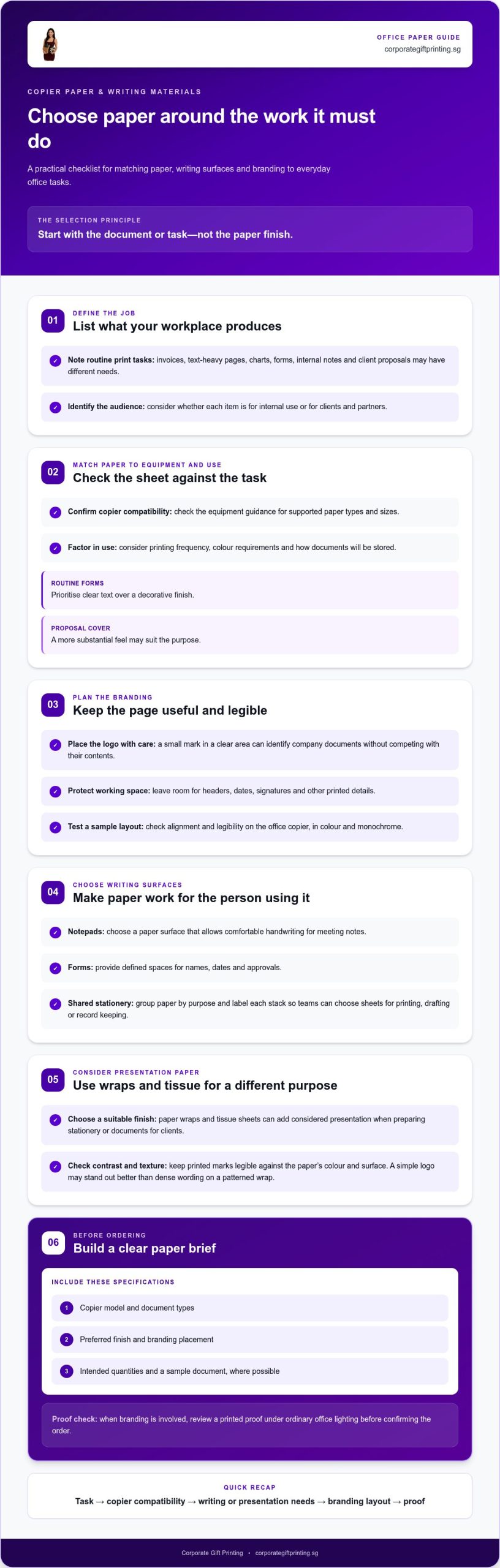
Paper affects print clarity, handling and presentation. Start with the documents your workplace produces. A team printing invoices has different needs from one preparing client proposals. List routine tasks before selecting copier paper, including text-heavy pages, charts, forms and internal notes. This helps prevent choosing paper that looks suitable but performs poorly in everyday use.
For copier paper, match the sheet to the machine and task. Check the equipment guidance for supported paper types and sizes. Then consider printing frequency, colour requirements and how documents will be stored. Clear text matters more than a decorative finish for routine forms. A more substantial feel may suit a proposal cover. Keep the intended use central.
Use branding sparingly on frequently printed sheets. A small logo in a clear area can identify company documents without competing with their contents. Leave room for headers, dates, signatures and printed details. Test a sample layout on the office copier before preparing a larger batch. Check alignment, legibility and the logo’s appearance in colour and monochrome to catch layout issues early.
Writing materials also depend on the right paper surface. Notepads for meeting notes should allow comfortable handwriting. Forms may need defined spaces for names, dates and approvals. If staff refill a shared stationery point, group paper by purpose and label each stack clearly. This makes replenishment easier and helps teams choose the right sheet for printing, drafting or record keeping.
Paper wraps and tissue sheets serve a different purpose. They can add a considered presentation when preparing stationery or documents for clients. Choose a finish that suits the item and the impression you want to create. Keep printed marks legible against the paper’s texture and colour. For example, a simple logo may stand out better than dense wording on a patterned wrap.
Before ordering, prepare a brief paper specification. Note the copier model, document types, preferred finish, branding placement and intended quantities. Include a sample document where possible, such as an invoice or proposal cover. Request a printed proof when branding is involved, then review it under ordinary office lighting. A clear brief helps align paper products with daily workflow and brand presentation.
For coordinated paper items and other workplace stationery, explore branded business stationery as part of your office supply planning.
Pens and writing instruments
A branded pen moves through everyday work. It may sit beside a meeting notebook, accompany a signed form or go home with a client. Choose it for its purpose first. A reception counter needs dependable pens for visitors, while a conference handout may call for a more considered feel. The setting guides material, style and branding choices.
Start with the writing experience. Compare how the pen feels in hand, how its ink looks and whether staff can write comfortably on common office paper. A ballpoint can suit forms and quick notes. A gel pen may give a smoother, darker line. Test samples on the paper your team uses, including notebooks and printed forms.
Next, consider construction and use. A lightweight pen is easy to carry in a folder or pocket. A sturdier body may feel more substantial in client meetings. Clip design matters when recipients attach pens to notebooks or document covers. For shared office use, a comfortable grip and clear writing matter more than decorative details.
Material can support a workplace’s purchasing priorities. Three listed sustainable pens are made from 91% recycled materials. Treat that figure as a material detail, not a substitute for assessing function. Compare each option’s writing feel, body finish and intended recipient. A pen for daily staff use may need different qualities from one presented at a business meeting.
Plan branding around the available surface. A compact logo is often easier to recognise than crowded text. Check its size, placement and colour against the pen body. If the design includes fine lines, review a proof at actual size. Confirm that the branding method can reproduce the artwork on the chosen material.
Use a short selection process before placing an order:
- Define the setting, such as desk use, meetings or client handouts.
- Choose a pen style and test its writing on workplace paper.
- Match body material and colour to the intended brand presentation.
- Review logo placement, legibility and artwork proof.
- Align the quantity with the planned recipients and use.
For example, an office preparing meeting folders could pair a comfortable pen with a notepad. Staff replenishing shared desks may instead prioritise a consistent everyday writing experience. These examples help distinguish practical stationery from presentation-focused items. Keep logo proportions consistent across the selected pens, even when body colours differ.
Record the chosen pen style, material, colour, branding position and artwork version in one order specification. This gives purchasing and administration teams a clear reference for repeat orders and helps maintain consistency when pens are used alongside business cards, folders or other branded stationery.
What is the minimum order quantity for custom-branded office supplies in Singapore?
There isn’t one minimum quantity for every branded office supply. The required order depends on the item, production method and branding setup. A Singapore order example dated 8 May 2025 required 500 customised plastic pens. That example illustrates one order, not a universal minimum.
Different products require different production steps. A printed notepad and a plastic pen have different surfaces and processes. Artwork, print area and number of colours can also affect production planning and the practical order quantity. Establish product and branding details before comparing quantities.
For a workplace order, start with intended use. Count staff who need regular supplies, then account for planned distribution to clients or visitors. Separate daily-use stationery from items prepared for meetings. This gives you a realistic quantity based on demand rather than an arbitrary bulk target.
Next, decide whether you need individual items or a coordinated set. A team, for example, may order pens and notepads for meeting rooms. Align quantities with the number of people receiving each set. If some items are for a wider audience, list them separately. Clear counts make the order specification easier to review.
Use this planning sequence:
- Choose the stationery item and its intended recipients.
- Estimate the quantity needed for staff or distribution.
- Specify logo artwork, colours and branding placement.
- Group items that will be supplied as one set.
- Submit the complete requirements for a project quotation.
The branding method matters, too. A single-colour logo may require a different production setup from detailed, multicolour artwork. Pen shape and print area can limit logo size, while paper products allow different layouts. Provide the final artwork and product details together so the proposed quantity reflects the complete job.
Plan the budget around the whole order, not just the number of pieces. Item choice, branding complexity, packaging and delivery requirements can affect the quoted total. Compare like with like: check that each quotation covers the same product, artwork, print method and delivery scope.
If a proposed quantity exceeds immediate needs, consider storage and future use. Pens and notepads need suitable storage to stay organised and ready for distribution. For an order supporting a meeting or staff welcome, count the intended recipients and any planned reserve stock. Let the purpose guide the final quantity.
For a precise request, provide the product type, required quantity, artwork, branding preferences and delivery details together. This gives the quotation process a clear starting point and helps you compare the proposed order with your workplace needs.
An order by United World College of South East Asia-East involved 50 eco-friendly notepads with pens, each with a single-colour logo. This shows that a branded stationery order can combine items and still use a defined quantity for a particular requirement. It does not establish a minimum for other buyers or products; the quantity should be confirmed against the intended recipients, the chosen items and the approved branding details.
When requesting a quotation, provide complete product and artwork specifications and ask for the quantity suited to that order. If it does not match your plans, discuss adjusting the item choice, branding method or distribution plan before proceeding. This keeps the order aligned with practical needs instead of treating one example as a general threshold.
How long does production and delivery of custom office supplies take in Singapore?
Production and delivery timing depends on the product and order details. A printed notepad, branded pen and paper folder involve different materials and production steps. The branding method, artwork readiness, order quantity and delivery arrangements also shape the schedule. Plan around these factors rather than assuming every stationery item follows the same timeline.
Artwork approval is an important planning step. Final files need to suit the chosen product and print area. If the logo’s size, colour or placement changes, the proof may need revision before production. Send approved artwork with clear specifications to reduce avoidable back-and-forth and give the order an organised starting point.
Production planning also depends on the item. A simple logo on a flat paper surface differs from detailed branding on a shaped pen. Multiple products in one order may require separate production steps. If a project combines notepads, pens and folders, define the artwork and finish for each item separately to give the schedule a clear structure.
Plan delivery around the destination and handover requirements. A single office address is simpler to coordinate than separate deliveries to several teams. Include the receiving location, access instructions and the person responsible for accepting the order. If supplies are needed for a staff welcome or client meeting, set the required arrival date first, then plan backwards through approval, production and dispatch.
To keep the process moving, prepare these details before requesting a schedule:
- Product types and quantities for each item.
- Final logo files and approved colour references.
- Branding method and placement for every product.
- Delivery address and any receiving instructions.
- The date the supplies need to be ready for use.
Build time for review into the plan. Check the proof for spelling, logo proportions and placement before approval. Gather feedback from those responsible for brand and purchasing decisions, then consolidate it. One approved version helps prevent conflicting instructions from slowing production.
For example, an office preparing meeting materials can list its notepads, pens and folders together. It can also specify which items need individual branding and where the complete order should be delivered. This practical brief helps align production steps with the intended use and delivery plan.
Share your product choices, artwork and required delivery date to plan a custom office supplies order with a clear production and delivery brief.
Corporate Gift Printing: Customized Bags & Pouches
Corporate Gift Printing helps businesses extend a coordinated identity beyond everyday stationery. Its Customized Bags & Pouches can welcome employees, thank clients or hold materials for business meetings. Choose a format based on what recipients will carry, then align the branding with your company’s visual identity.
For a broader corporate gifting plan, consider pairing bags with Business Stationeries, Travel Accessories or Electronic Corporate Gifts. Each serves a different purpose, so choose products according to the recipient and occasion. A pouch can organise small essentials, while a travel accessory can support a work trip. Aim for a useful, considered gift that reflects your business.
Contact Corporate Gift Printing to discuss branded bags and pouches for your workplace.
Turn Everyday Essentials Into a Cohesive Brand Experience
Think beyond individual items. A consistent brand experience comes from choosing products that connect with your workplace, your people and the relationships you value. Thoughtful office supplies branding in Singapore can form part of a broader approach to how your business presents itself, from everyday work to client appreciation.
For occasions that call for more than stationery, Corporate Gift Printing offers Customized Bags & Pouches, Electronic Corporate Gifts and Travel Accessories. These can complement a business gifting plan while serving practical needs. Choose according to the recipient and how you want the gesture to reflect your company.
Set out your intended recipients, preferred items and branding direction, then take the next step with a clear project brief. Contact Corporate Gift Printing to discuss branded gifts and business essentials for your organisation. A considered choice can help every detail feel purposeful and true to your brand.
Frequently Asked Questions
What office supplies can be custom branded in Singapore?
Common choices include business stationery, pens, notebooks, folders and other paper items. Companies can also brand practical corporate gifts such as bags and pouches, travel accessories or electronic gifts. Match the item to its purpose: stationery supports regular office use, while a pouch or travel accessory may suit a client or employee gift. Choose branding to suit the product’s surface and available print area.
Which Singapore suppliers offer branded office stationery and corporate gifts?
Corporate Gift Printing offers Business Stationeries and corporate gift categories including Customized Bags & Pouches, Electronic Corporate Gifts and Travel Accessories. For a workplace project, first define the intended recipients and purpose. An office may need stationery for routine use, while a client appreciation plan may call for a useful gift. A clear list helps align product choices with your company’s identity.
How much do branded pens, notebooks, folders, and desk accessories cost in Singapore?
The price depends on the order and is provided after a quote request. Factors include the item, quantity, branding method, artwork requirements and delivery arrangements. A pen with a simple logo and a coordinated stationery set involve different specifications. For a useful quotation, list each product, quantity and branding preference together, and state whether items need packaging or delivery as sets.