What makes a travel gift memorable: a prominent logo, or an item someone reaches for on every trip? When choosing branded travel accessories Singapore recipients will genuinely use, start with the person and their journey, not the novelty of the product. A passport holder may suit someone who regularly carries travel documents, while a pouch can help keep smaller essentials together.
A good travel gift feels practical without looking generic, and polished without letting the branding overwhelm the item. This guide explains how to match accessories to recipients and travel contexts, compare options, and consider how logo placement affects the finished gift. Corporate Gift Printing brings sourcing, customisation and professional printing together to help businesses turn a gifting brief into a branded travel accessory.
Key Takeaways
- Match the accessory to recipients’ travel habits and the purpose of the gift.
- Compare categories by likely use, audience and branding opportunity.
- Assess practical value, brand fit, perceived quality and logo placement before choosing.
- Prepare a clear brief covering recipients, occasion, quantity, brand assets and presentation.
- Use thoughtful sourcing and customisation to create a cohesive corporate gift.
Why branded travel accessories make thoughtful corporate gifts in Singapore
A useful corporate gift can stay with its recipient long after the meeting, project milestone or staff occasion that prompted it. Branded travel accessories are items used to prepare for, organise or make a journey more comfortable, customised with an organisation’s branding. Their value comes from pairing that identity with something that suits the person receiving it, not simply adding a logo to a product.
Novelty may attract attention initially, but usefulness and recipient fit give a gift a lasting purpose. An accessory suited to someone’s role or travel routine feels considered; one chosen mainly because it looks unusual may go unused. The item’s style and customisation should also reflect the organisation and the relationship behind the gift, rather than making it feel like an oversized advertisement.
A travel accessory is a suitable corporate gift when it answers a real need and reflects the relationship it is meant to recognise.
Which gifting goals suit travel accessories?
Decide what the gift should communicate before choosing a product. The same category can serve different purposes, but the selection and presentation should match the intended impression:
- Client appreciation: Consider the client’s likely travel needs so the gesture feels useful and sincere, rather than routine.
- Partner recognition: Choose an item that conveys professional respect and acknowledges the value of working together.
- Employee gifting: Look for a gift that expresses appreciation or shared identity while remaining suitable for different roles and routines.
Keeping these objectives distinct helps guide decisions about the item, branding and presentation. It also prevents a relationship-building gift from being judged solely by a marketing outcome.
How to start with the recipient, not the product
Before settling on an item, consider the recipient’s role, travel habits and likely use. Someone who travels for work may value a way to organise essentials. For a broad employee group, a versatile accessory may suit more people. Treat these as starting points, not assumptions about every individual.
Distinguish gifts for a defined group from those intended for a broad audience. For a specific group, match the item to a known journey or use case. For a wider audience, prioritise straightforward usefulness and a design that works across different preferences. This makes the choice more deliberate and reduces the risk of a one-size-fits-all gift feeling generic.
Finally, check that the branding complements the item. A restrained logo can support a polished impression, while a mark that dominates the surface may distract from the accessory’s everyday purpose. Corporate Gift Printing brings sourcing and customisation together to help businesses translate their gifting intentions into branded travel accessories.
Branded travel accessory categories and the journeys they suit
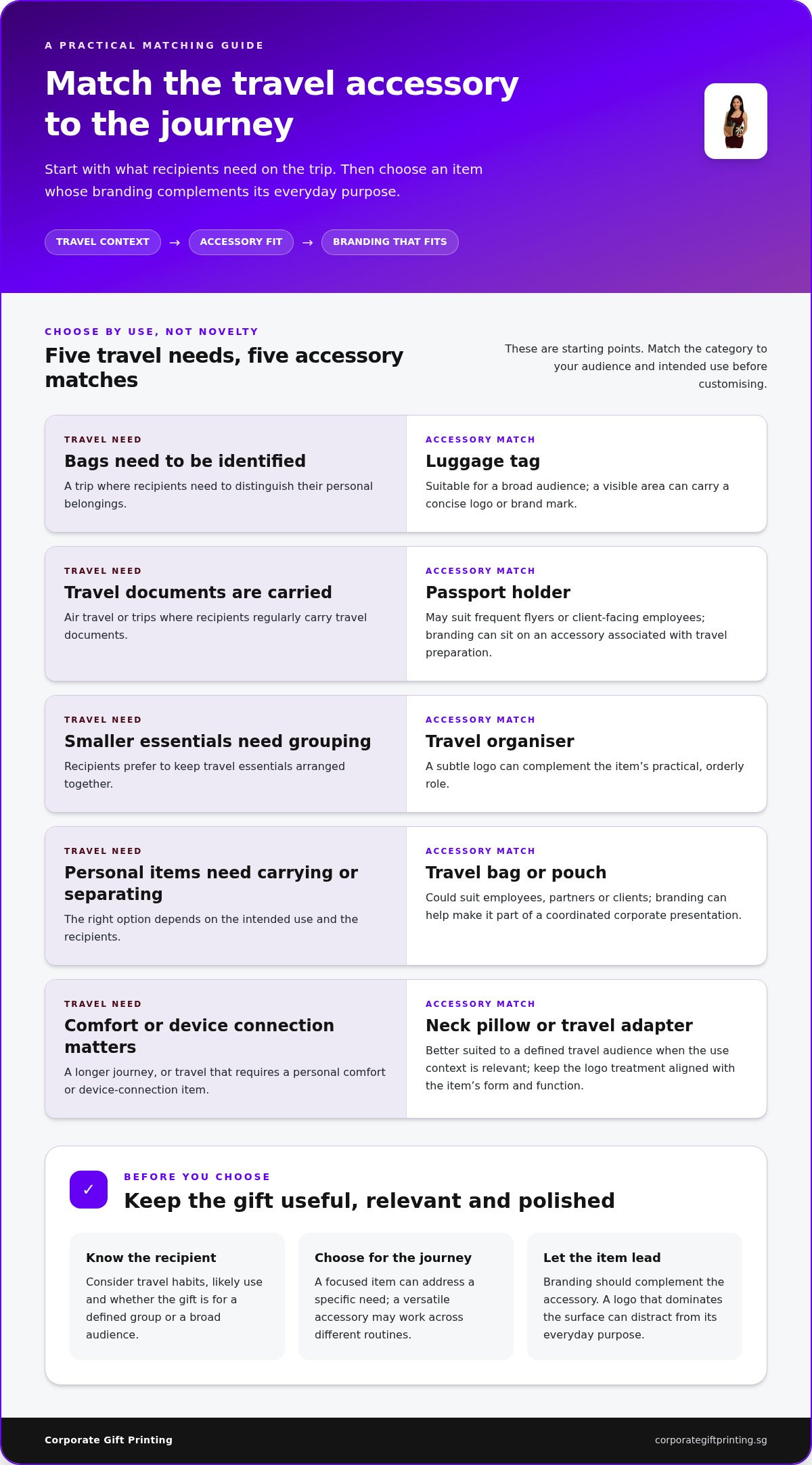
Different accessories serve different moments in a journey. A luggage-related item can help identify belongings, while an organiser keeps travel essentials together. The right choice depends on the recipients, how they are likely to travel and what the gift should communicate. Use the comparisons below as a starting point, then weigh each option against your audience and brief.
| Category | Travel context | Potential recipient and use | Branding opportunity |
|---|---|---|---|
| Luggage tags | Trips where bags need to be identified | Suitable for a broad audience; helps distinguish personal belongings | A visible area can carry a concise logo or brand mark |
| Passport holders | Air travel and trips involving travel documents | May suit frequent flyers or client-facing employees who carry documents | Branding can be placed on an accessory associated with travel preparation |
| Travel organisers | Journeys where recipients want to group smaller essentials | Useful for travellers who prefer belongings arranged in one place | A subtle logo can complement the item’s practical, orderly role |
| Travel bags and pouches | Trips requiring a way to carry or separate personal items | Could suit employees, partners or clients, depending on the intended use | Branding can make the item part of a coordinated corporate presentation |
| Neck pillows or travel adapters | Longer journeys or travel requiring personal comfort or device connection | Better suited to a defined travel audience when the use context is relevant | Keep the logo treatment aligned with the item’s form and function |
These are examples of accessory categories, not a suggestion that every traveller needs the same thing. When choosing branded travel accessories for a corporate programme, match the category to the audience and intended use before deciding on customisation.
Match the accessory to the travel context
Frequent business travellers may appreciate accessories that support repeated journeys or keep essentials organised. Recipients who travel occasionally may get more use from a straightforward item with broader everyday usefulness. Consider how the item will be carried and stored, too: a compact accessory may suit people who prefer to travel light. Use these as selection cues, then compare them with what you know about the intended audience.
Avoid assuming that a job title tells you exactly how someone travels. A team may include regular flyers and colleagues who rarely travel, so a shared gift should work across different routines. For a defined group, you can tailor the category to a known journey or use case.
Choose between a single gift and a coordinated set
One focused item can make a clear, practical gift when it addresses a specific need or suits a broad audience. A coordinated selection may work for a more curated presentation, especially when the items share a consistent branding approach. The goal is coherence, not simply adding more products. Consider how sourcing and customisation can bring the selection together, then explore branded travel accessories suited to your gifting brief.
How to compare branded travel accessories before placing a corporate order
Judge a shortlist on more than appearance. Apply the same criteria to each option: whether it has a clear use for the intended audience, fits your organisation’s identity, suits the occasion and can be branded without losing its visual appeal. This helps you compare a practical everyday item with a more elevated gift without relying on novelty alone.
A strong branded gift is useful, appropriate for its recipient and visually consistent with the organisation it represents.
Before deciding, assess each candidate against these questions:
- Practical usefulness: Does the item address a plausible need for this audience, or is its appeal mainly decorative?
- Brand fit: Does its overall look suit the organisation’s identity and the relationship behind the gift?
- Perceived quality: Do the finish and construction feel suitable for the item’s purpose and presentation?
- Audience suitability: Is the item appropriate for the recipients as a group, including differences in role or travel routine?
These criteria help distinguish an attractive concept from a well-considered order. For corporate gifting, the strongest branded travel accessories are those where the item, audience and branding make sense together.
Evaluate branding, logo placement, and visual clarity
Logo size and placement affect both legibility and the item’s overall appearance. A mark that is too small or has little contrast may be difficult to recognise; one that dominates the surface can make the accessory feel more promotional than considered. Look at the available space, the item’s shape and how the logo will appear when the accessory is in use. Aim for a clear brand impression that still lets the item feel practical.
Provide accurate brand assets and concise visual guidance for customisation. Include the preferred logo version, colour guidance and any rules for spacing or proportions. The branding should suit both the item and your visual identity. Reviewing these elements together helps keep the finished presentation consistent without assuming that one treatment will suit every project.
Balance perceived quality with everyday practicality
Consider quality in context: does the finish feel appropriate for the item’s purpose, and does its form suit the way recipients may use it? A more elaborate accessory is not automatically a better choice. For a broad employee group, a straightforward, useful item may be more relevant than a specialised option that suits only a few people.
Apply a consistent standard across the programme. If you choose several categories, check that their presentation and branding feel aligned, even if each serves a different purpose. This creates a considered overall impression and helps the gift reflect the care behind the decision, rather than the complexity of the item.
Plan a branded travel accessories order with a clear corporate brief
A clear brief turns a gifting intention into practical decisions about the item, recipients and branding. It gives sourcing and customisation a shared direction, reducing the chance that important details are considered only after a product has been selected. Use this planning sequence to organise the project before approving a final item.
Prepare the information that shapes the brief
Start with the purpose and recipients, then gather the details that will guide selection and customisation. Note the travel context where relevant, along with approved brand assets, quantity and presentation expectations. A focused brief connects the gifting goal to a suitable item and keeps key decisions in one place.
- Set the gifting objective. State whether the order is intended to recognise clients, acknowledge partners or appreciate employees. Define the impression you want the gift to convey, such as professional respect or a shared sense of identity.
- Describe the recipients. Identify the group and any relevant differences in role, travel habits or likely use. Note whether the gift is for a specific audience or a broader group with varied routines.
- Record the occasion and context. Explain why the gift is being given and whether a particular journey or type of travel informs the choice. This gives the item a clearer purpose.
- Set the order scope. Include the intended quantity and any presentation requirements. If the order serves different recipient groups, outline how the selection or presentation should remain coherent across them.
- Gather brand materials. Provide approved logo files, brand colours and visual guidelines. Include preferences for logo size or placement where your organisation has them, so customisation follows a consistent direction.
- Define what approval requires. Identify who will review the proposed item and branding, and what they need to assess. This could include suitability, visual clarity and fit with the occasion.
A well-prepared brief helps Corporate Gift Printing connect your objective with sourcing, customisation and professional printing. Explore tailored corporate gift solutions to develop your branded travel accessory idea.
Review the proposed item and branding together
Assess the accessory and its logo treatment as one finished brand experience, rather than approving each in isolation. Consider whether the item suits the intended recipients and occasion, whether the logo remains clear without dominating the design, and whether the presentation reflects your organisation. Reviewing a visual proposal can help decision-makers assess the same details.
Gather feedback from the people responsible for brand and gifting decisions, then resolve changes before approval. Clear, consolidated feedback helps carry the original brief through to the finished branded item.
Bring your branded travel accessory idea to life with Corporate Gift Printing
A considered gifting programme follows a clear sequence: recipient first, travel context next, then branding and practical fit together. This keeps the item grounded in the people who will receive it and the purpose behind the gesture. The aim is not simply to add a logo, but to connect a suitable travel accessory with a cohesive brand presentation.
Corporate Gift Printing supports businesses with sourcing, customisation and professional printing for corporate gifts. A clear brief gives each step direction by recording the audience, gifting purpose, intended quantity and brand requirements. Whether the gift is for clients, partners or employees, aligning these details helps turn an initial idea into a more considered branded item.
What a tailored sourcing and customisation process contributes
Sourcing connects the gifting objective to an appropriate travel accessory, while customisation and logo printing bring the organisation’s identity to the item. These decisions work best together. A suitable accessory with well-judged branding can feel purposeful and professional; a mismatch between the item, its audience and its visual treatment can weaken the presentation.
A well-prepared brief gives sourcing and customisation a shared reference point, from the intended use to the approved brand assets. It also helps keep different items within one programme visually aligned, even when they serve distinct purposes. The result is a gift selected with its recipient and presentation in mind, rather than a logo applied as an afterthought.
Make the next step clear for your gifting programme
Bring the essentials together before developing the idea: who the recipients are, what the gift should communicate, what travel context informs the choice and which brand requirements should guide customisation. Add the intended quantity and presentation expectations, then identify who will review the proposed item and branding. This gives decision-makers a practical basis for discussing suitability, visual clarity and fit with the occasion.
Once these priorities are clear, move from a broad intention to a specific direction for sourcing and customisation. If the audience includes different groups, note where their needs differ and where a consistent branded presentation should remain. These details help shape a solution around the programme rather than forcing the programme around a product.
Turn your gifting brief into a cohesive branded travel accessory with Corporate Gift Printing’s sourcing and customisation support. Explore tailored corporate gift solutions for your programme.
Make your next gifting decision count
A corporate gift can express care while representing your organisation. As you plan branded travel accessories recipients may carry beyond the occasion, let the relationship guide the final choice: what would feel genuinely useful, and what impression do you want the gift to leave?
Put that intention into a clear brief, then shape it into an item and presentation that suit your brand. Corporate Gift Printing helps businesses move from gifting idea to customised travel accessory through sourcing and professional printing, with options including travel accessories and customised bags and pouches.
Explore custom corporate gift solutions and take the next step towards a thoughtful gift your recipients can make their own.
Frequently Asked Questions
What are branded travel accessories?
Branded travel accessories are practical items used during a journey that carry an organisation’s logo or other approved branding. Examples include luggage tags, passport holders and travel organisers. For a corporate programme, the aim is to pair an item’s travel-related purpose with a suitable brand presentation. Corporate Gift Printing sources and customises travel accessories for businesses, including gifts for clients, partners and employees.
Which travel accessories work well as corporate gifts?
The right choice depends on the audience and occasion. Luggage tags or passport holders may suit recipients who travel by air, while organisers can appeal to people who prefer to keep small essentials together. A travel pouch may work for a wider group. Consider whether recipients are likely to use the item and whether its presentation suits the relationship.
How do I choose branded travel accessories for employees or clients?
Start with what you know about the recipient group, rather than choosing an item just because it carries a prominent logo. For employees with varied routines, consider a broadly useful category that does not depend on frequent travel. For a client group with a clear travel context, a more focused item may feel relevant. Also consider the occasion, the intended impression and whether the accessory’s style suits your organisation.
Can travel accessories be customised with a company logo?
Yes. Corporate Gift Printing provides logo printing and customisation for corporate gifts, including travel accessories. For a considered result, provide approved logo artwork and brand guidance, then review how the mark looks on the selected item. Its scale, position and contrast affect how clearly it reads and how naturally it fits the accessory. The visual treatment should support recognition without making the item feel like an advertisement.
What should I include in a corporate travel gift brief?
Include the gifting purpose, recipient groups, occasion, intended quantity and any relevant travel context. Add approved logo files, brand colours and visual guidelines, along with presentation preferences, such as whether gifts should feel consistent across different recipient groups. Identify who will review the proposed item and branding, too. A named decision-maker and consolidated feedback can keep approvals clear and reduce conflicting directions.
How can I make branded travel gifts feel useful rather than promotional?
Choose an accessory for a plausible recipient need, then keep the logo treatment in proportion to the item. For a diverse employee group, a straightforward category with everyday relevance may be more useful than one suited only to a particular travel routine. Consider whether the accessory would still feel appropriate if the logo were less prominent. This helps keep the gift’s practical purpose at the centre.
Are branded travel accessories suitable for business events and employee recognition?
They can suit both, provided the item matches the purpose and audience. For a business event, a travel accessory may be useful for attendees whose travel needs are relevant to the occasion. For employee recognition, the same category can express appreciation when it fits recipients’ routines. Corporate Gift Printing helps businesses connect a gifting brief to a branded item through sourcing and customisation.