Only 22% of employees in Singapore say they feel genuinely appreciated at work, according to Achievers’ April 2026 research. That makes employee gifts Singapore companies plan more than a seasonal checkbox: the right choice can make recognition tangible, while a generic item may miss the people it’s meant to thank.
Choosing one gift for a team with different preferences takes care. The item should suit the occasion, feel useful to recipients and reflect your company identity without letting a logo overshadow the gesture. Customised bags and pouches, electronic gifts, travel accessories, business stationery and luxury gifts offer different ways to make appreciation more personal.
This guide explains how to match gifts to occasions and recipient groups, create a polished branded experience, and plan customisation and distribution. It also outlines key Singapore tax considerations, so you can plan thoughtfully while keeping relevant IRAS guidance in view.
Key Takeaways
- Choose employee gifts Singapore teams will value by starting with the recognition goal, then matching the gift to the occasion and recipient group.
- Use a five-step decision framework to clarify your purpose, group recipients, set constraints, shortlist options and review your choice.
- Compare gift categories such as bags and pouches, electronic gifts, travel accessories, stationery and luxury gifts against the moment you’re recognising.
- Build a smoother gifting process with a clear recipient list, a concise brief, careful logo artwork review and planned distribution.
- Make branded gifts feel considered by treating logo printing as part of the presentation, not a substitute for genuine appreciation.
Why employee gifts in Singapore work best when they recognise people, not just occasions
Employee gifts are intentional tokens of workplace recognition. Their value comes not simply from what’s inside the wrapping, but from the thought behind the gesture. When planning employee gifts Singapore teams will appreciate, begin with the reason for giving. A gift that welcomes a new colleague serves a different purpose from one that thanks a team for a contribution or marks a festive occasion.
That distinction matters because recognition is part of the employee experience, not just a procurement exercise. A considered gift can make appreciation tangible when it acknowledges a person or moment specifically. The broader principles behind the psychology of employee recognition also point to the importance of making recognition meaningful and connected to the recipient, rather than treating it as a routine distribution.
By contrast, handing out merchandise with a company logo alone may communicate the brand more clearly than the appreciation behind it. Branding can support the gesture, but it shouldn’t replace a clear message. A useful item chosen with care is more likely to feel relevant than an unrelated promotional product because it shows that someone considered how the recipient might use it.
Recipient, purpose and usefulness together determine whether a gift feels like a fitting gesture or just another item. Keep these three considerations in view to move from “What can we give everyone?” to a more purposeful decision about what the gift should say and do.
What should an employee gift communicate?
Decide what the gesture is meant to express before selecting an item. Is it recognition for a contribution, a warm welcome for a new joiner, or a way to mark an occasion? The message should align with your organisation’s values and the employee experience you want to foster. A practical gift can express care without feeling overstated, while a logo added thoughtfully can connect it to the company. The item should still make sense to the recipient without the branding.
When do Singapore employers give employee gifts?
Work anniversaries, onboarding, achievements and festive occasions each call for a different kind of attention. A welcome gift can help a new colleague feel included; a milestone gift can acknowledge their time with the organisation; and recognition for an achievement should make the contribution clear. Festive gifting may coincide with Chinese New Year, Hari Raya, Deepavali or Christmas, but employees won’t all celebrate the same occasions.
For a diverse workforce, use inclusive wording that expresses appreciation without assuming anyone’s beliefs or traditions. A message such as “With thanks for your contribution” can suit a broad employee group, while a greeting tied to a particular celebration can be reserved for communications where it’s appropriate. Timing also shapes how the gesture lands: give recognition close to the milestone or contribution it acknowledges, rather than relying on a single annual distribution to cover every purpose.
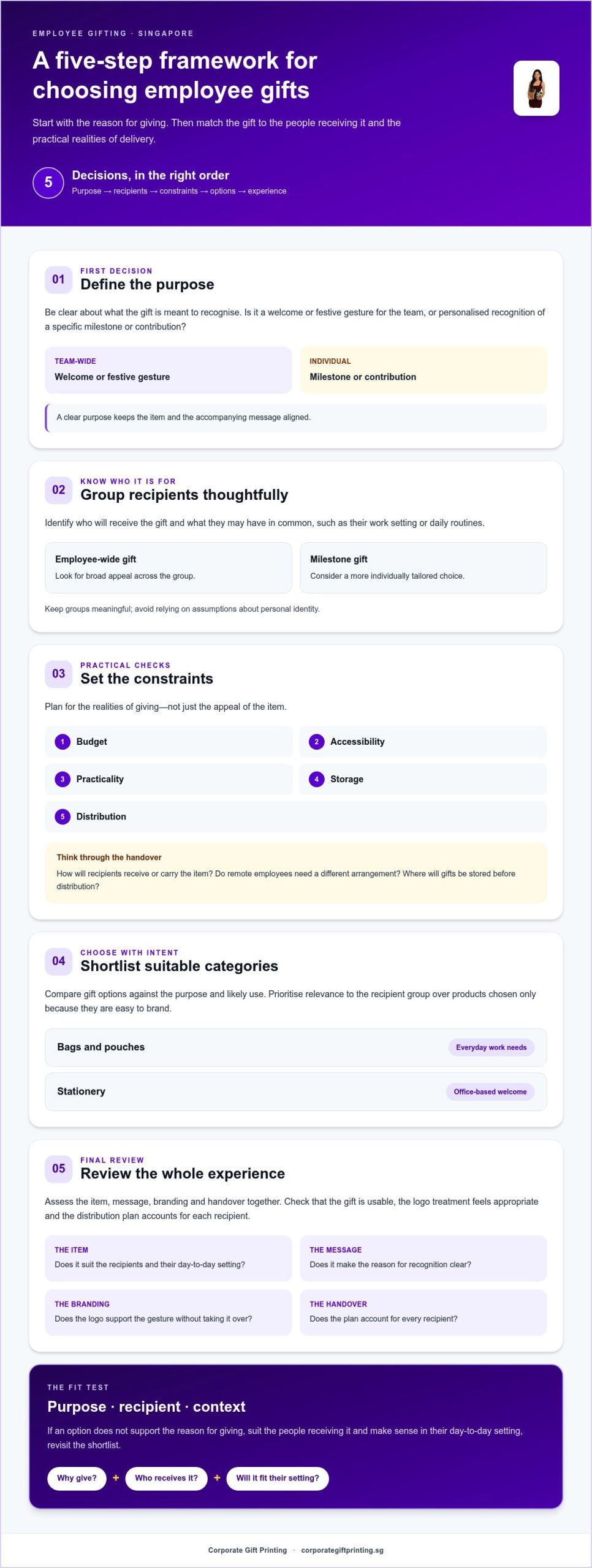
How to choose employee gifts in Singapore: a five-step decision framework
A thoughtful selection process starts before you browse gift categories. To choose employee gifts Singapore teams can use and appreciate, work from the recognition goal towards a suitable item instead of choosing merchandise first and trying to fit a message around it. The steps below help you account for both the recipient experience and the practical work of giving.
- Define the purpose. Decide whether the gift is for the whole team, such as a welcome or festive gesture, or for personalised recognition of a specific milestone or contribution. A clear purpose keeps the item and accompanying message aligned. For a research-based perspective on why recognition matters at work, see this research on recognition and employee performance.
- Group recipients. Identify who will receive the gift and what they may have in common, such as work setting or daily routines. An employee-wide gift needs broad appeal; a milestone gift can be more individually tailored. Keep groups meaningful rather than relying on assumptions about personal identity.
- Set constraints. Consider your budget, accessibility, practicality, storage and distribution. Think about how recipients will receive or carry the item, whether remote employees need a different arrangement, and how gifts can be stored before distribution. These details help prevent a good idea from becoming difficult to deliver.
- Shortlist suitable categories. Compare options against the purpose and likely use. A bag or pouch may suit everyday work needs, while stationery could be appropriate for an office-based welcome. Favour items that feel relevant to the recipient group over products selected only because they’re easy to brand.
- Review the whole experience. Consider the item, message, branding and handover together. Check that the choice is usable, the logo treatment feels appropriate and the distribution plan accounts for each recipient. A polished gift should make the recognition clear without making the branding the main event.
The best fit depends on purpose, recipient and context. Use those three factors as a simple test: if an option doesn’t support the reason for giving, suit the people receiving it and make sense in their day-to-day setting, revisit the shortlist.
How should you account for different employee preferences?
Consider roles, work settings and daily routines, including whether employees work on-site or remotely. Avoid guessing preferences from age, gender, family status or cultural background. If one item may not suit everyone, a small curated choice can offer flexibility while keeping the experience consistent. Keep the options practical to store and distribute, and make the selection process accessible to the intended recipients.
How much branding is right for an employee gift?
Logo visibility, placement and print clarity all shape how professional a gift feels. Keep the treatment consistent with your organisation’s identity and proportionate to the item’s intended use. Branding should complement the gift, not overwhelm it. If stationery fits the brief, explore this business stationery gifting guide. A considered brief can also help customise branded employee gifts around the intended recipients.
Employee gift ideas in Singapore: match the category to the moment
The right category depends on what the gift should do for the recipient. An item intended for everyday work may need a different balance of usefulness and branding from a gift marking a personal milestone. Use the comparisons below to narrow the options for employee gifts Singapore employers are considering, then assess each item against the recipient group and occasion.
| Gift category | Suitable context | Practical use and branding | Consideration |
|---|---|---|---|
| Bags and pouches | Team-wide gifting or a welcome gesture | Can support carrying work essentials; a considered logo placement keeps the item professional. | Think about how recipients will use and store it, and whether the format suits the group. |
| Electronic gifts | Recognition where practical technology supports the objective | Branding can identify the organisation while keeping the item’s intended use central. | Specific features and compatibility vary by item, so avoid assuming one option suits every recipient. |
| Travel accessories | Frequent work travel or a particular employee reward | A subtle brand treatment can connect the gift to the organisation without dominating its use. | It may be less relevant for employees whose roles don’t involve travel. |
| Business stationery | Onboarding or appreciation for employees likely to use stationery at work | Clear, consistent branding can give regularly used items a polished company identity. | Consider whether recipients’ working routines make stationery useful to them. |
| Luxury gifts | A significant milestone or high-value recognition | Refined branding can preserve a considered presentation while acknowledging the company’s role. | Use this category where the occasion and recognition objective warrant a more elevated gesture. |
Which practical gifts suit everyday work and travel?
Bags and pouches can be a natural fit when recipients need to carry work essentials. Focus on the intended use, then treat logo size and placement as part of the overall presentation rather than the main attraction. Travel accessories make more sense for employees who travel regularly or for a reward tied to a particular contribution; they may be less useful as a universal team gift. Business stationery can suit onboarding or everyday appreciation when recipients are likely to use it in their working routines. For stationery, a business stationery gifting guide can help shape the brief.
When do electronic or luxury gifts make sense?
Electronic gifts are worth considering when practical technology aligns with the reason for giving and the recipients’ needs. Keep the choice grounded in its intended use rather than assuming a particular feature will matter to everyone. A luxury gift can suit a milestone or high-value recognition when the elevated nature of the gesture matches the significance of the moment. Consider how branding, presentation and the accompanying message work together. For more on this category, explore the luxury corporate gifts guide.
Across every category, apply the same test: will the recipient understand why this item was chosen, and can the branding sit naturally alongside its use? Matching the category to the moment helps a corporate gift feel intentional, not merely selected from a catalogue.
Plan employee gifting in Singapore with clear communication and careful checks
A well-chosen gift still needs a well-managed process. For employee gifts Singapore teams receive across different work arrangements, plan from the recipient list to distribution, with clear ownership at each stage. Allow time for internal approvals, logo artwork review and delivery coordination so final checks don’t become last-minute decisions.
- Prepare the recipient list. Confirm who should receive a gift, check names and quantities, and account for employees who work remotely or across Singapore. Keep the list current and handle recipient information carefully.
- Write a concise brief. Record the purpose, intended recipients, occasion, gift category, branding needs and distribution approach. A clear brief helps internal reviewers assess whether the choice and message suit the recognition objective.
- Arrange artwork and review. Provide the approved logo artwork and specify the intended placement and presentation. Review the artwork carefully before production, checking spelling, proportions, clarity and consistency with your organisation’s brand identity.
- Secure internal approval. Give relevant decision-makers time to review the item, message, artwork and planned quantities together. Resolving feedback at this stage helps keep later arrangements aligned with the approved brief.
- Coordinate distribution. Plan how gifts will reach on-site and remote employees, including any separate arrangements needed for a nationally dispersed workforce. Check quantities against the recipient list and coordinate delivery details before the intended occasion.
Keep communication warm and direct. Explain why the organisation is giving the gift, whether it marks a milestone, welcomes a colleague or expresses appreciation. That context makes the gesture easier to understand and less likely to feel like a routine merchandise handout.
How can employers make employee gifting inclusive?
Use neutral, appreciative wording that doesn’t presume someone’s beliefs, celebrations or personal preferences. If one gift may not suit every employee, offer a thoughtful alternative while keeping the recognition consistent. Explain the purpose without making the gesture feel transactional. A brief message acknowledging the team’s contribution can give the gift meaning without turning appreciation into a performance or exchange.
What should a company check before distributing gifts?
Before distribution, compare the final plan against the approved brief. Confirm recipient quantities, spelling, approved artwork and intended logo presentation. Check that the distribution approach covers on-site, remote and nationally dispersed employees, and that delivery coordination matches the planned handover. If details change, update the list and communicate the revision to the people managing distribution.
Gifting etiquette guides how a gesture feels; tax treatment depends on current official guidance. Don’t assume that a gift’s occasion, format or value determines its treatment without checking the latest IRAS guidance for the specific circumstances. If you’re unsure how the rules apply to your organisation, consult IRAS or a qualified tax professional rather than relying on a general gifting rule.
With a considered brief and careful coordination, custom sourcing and logo printing can help turn a recognition objective into a polished branded gift. Plan custom branded employee gifts with a clear purpose, approved artwork and distribution needs in view.
Turn your employee gifting brief into custom branded gifts
A clear brief helps turn an employee recognition objective into a gift that feels considered and reflects your organisation. Corporate Gift Printing works with businesses in Singapore to source and customise employee gifts, with company-logo branding across categories including bags and pouches, electronic gifts, travel accessories, business stationery and luxury gifts.
Start with the reason for giving, then connect it to the recipient group and a suitable category. A welcome gift for new colleagues, for example, may call for a different choice from a gift marking a team milestone. The brief should also explain the impression you want the gift to leave. This gives sourcing and customisation a clear direction instead of making the logo the only point of reference.
Think about the finished item as a whole. Its purpose, usefulness, presentation and brand treatment should work together. Logo printing can make a gift recognisably yours, but the gesture feels more sincere when the item itself suits the people receiving it. This approach can help employee gifts Singapore companies give feel consistent with their identity and relevant to the occasion.
What should an employee gifting brief include?
Give the brief enough detail to guide a considered choice without overcomplicating it. Include the occasion, recipient group, desired impression and preferred gift categories. Add approved company-logo artwork and any guidance on how the brand should appear, so the customisation can be assessed against the organisation’s identity.
- Purpose and recipients: Explain what the gift recognises and who will receive it.
- Category and presentation: Note suitable categories and the intended look and feel.
- Artwork and brand use: Share approved logo files and relevant brand guidance.
- Review and distribution: Identify internal reviewers and outline how gifts need to reach recipients.
Including distribution needs and review requirements early helps keep the project organised. It also gives everyone involved a shared reference as choices, artwork and arrangements are reviewed, without setting a delivery timeline before the project details are established.
How does custom branding support a polished employee gift?
Logo placement should complement the item’s purpose rather than overpower it. A considered position and clear print presentation can connect a gift to the organisation while keeping the recipient’s experience central. Corporate Gift Printing brings sourcing and logo printing together to translate the brief into a finished branded gift across relevant categories.
Share your gifting objective, recipient group and preferred categories with Corporate Gift Printing to explore a tailored branded solution for your employee gifting programme.
Make your next gifting decision a lasting expression of appreciation
A thoughtful employee gifting programme can grow with your team. Treat each occasion as a chance to learn what feels relevant, then use that insight to shape future choices. A simple follow-up, such as inviting employees to share what they found useful, can help your next brief become more considered without turning appreciation into a formal exercise.
For employee gifts Singapore organisations can make their own, connect your recognition objective with a suitable item and a brand presentation that feels natural. Corporate Gift Printing supports businesses with custom sourcing and logo printing across bags and pouches, electronics, travel accessories, stationery and luxury gifts throughout Singapore.
Bring your gifting objective into focus and explore a tailored branded solution for your team. Explore custom employee gifts for your company, and take the next step towards making appreciation tangible.
Frequently Asked Questions
What are good employee gifts in Singapore?
Good employee gifts in Singapore are useful for the recipient and appropriate to the reason for giving. For a new joiner, consider something that supports their first weeks at work; for a colleague who travels regularly, a travel accessory may make more sense. The best option isn’t automatically the most elaborate. Choose an item your team can use, then make its presentation feel considered and connected to the occasion.
How do I choose gifts for employees with different preferences?
Start with shared practical needs rather than assumptions about age, gender or background. For example, if employees work in different settings, avoid choosing an item that only suits an office desk. You could offer a small selection of equally thoughtful options and let recipients choose, or use different categories for clearly distinct work groups. Keep the choice manageable and make sure each option carries the same message of appreciation.
Can employee gifts be customised with a company logo?
Yes. Corporate Gift Printing sources and customises business gifts with company-logo branding. Share approved logo artwork and any brand-use guidance, then review how the logo appears on the selected item before proceeding. A logo can help connect the gift to your organisation, but it needn’t dominate the design. For instance, a restrained placement can preserve the item’s professional feel while still making the company identity clear.
When should Singapore companies give employee gifts?
Companies can give gifts when recognition feels relevant, such as during onboarding, for a work anniversary, after an achievement or during a festive period. For a milestone, giving close to the date helps link the gesture to the person’s contribution. For broader team gifting, plan around the occasion and communicate the purpose clearly. In a diverse workplace, use inclusive wording and avoid assuming that every employee celebrates the same holiday.
Are gifts to employees taxable in Singapore?
Some festive or special-occasion gifts aren’t taxable if their value doesn’t exceed S$200 per occasion, according to IRAS guidance. If the gift exceeds S$200, its full value is taxable, not only the amount above the threshold. The concession doesn’t apply to performance-based rewards, which are treated as employment income; cash vouchers are generally taxable too. Tax treatment depends on the circumstances, so check current IRAS guidance before making decisions.
How can a company make branded employee gifts feel thoughtful?
Pair the item with a short, specific message that explains why it’s being given. For example, a note welcoming a new colleague creates a different impression from one thanking a team for a particular contribution. Use branding as a supporting detail, not the entire message. Clear logo artwork, a suitable presentation and a personal note can work together to make a company gift feel intentional rather than like routine promotional merchandise.