What makes a corporate gift memorable is often not its price, but how well it suits the recipient and the occasion. For businesses in Singapore, a thoughtful corporate gifting strategy 2026 starts with a clear purpose: decide what the gift should communicate before choosing an item.
Gifting can strengthen business relationships, but a generic choice may feel disconnected from your values or the recipient’s needs. Clients, employees, and partners can have different expectations, too. A clear plan helps your team make considered choices and create a consistent experience across each initiative.
In this guide, you’ll learn how to set a purpose for each gifting programme, choose appropriate gifts for different recipients, and coordinate selection, branding, and distribution. From customized bags and travel accessories to business stationery and electronic corporate gifts, the right item can express your company’s identity with care. A practical, repeatable plan helps turn that intention into a polished gesture.
Key Takeaways
- Build your corporate gifting strategy 2026 around a clear objective, with distinct plans for employees, clients, partners, and prospects.
- Use recipient needs, practical usefulness, and brand fit to guide gift selection.
- Match gift categories, from bags and travel accessories to electronics, stationery, and luxury gifts, to the purpose of each initiative.
- Coordinate approvals, customization, distribution, and follow-up to create a consistent recipient experience.
- Review each initiative to learn what resonated and improve future gifting decisions.
Why a Corporate Gifting Strategy Matters in 2026
A gift can acknowledge a contribution, welcome a new colleague, or show a client that you value the relationship. Without a clear purpose, even a well-made item may feel generic or arrive at the wrong moment. A corporate gifting strategy 2026 gives your team a shared way to decide who a gift is for, what it should communicate, how it should reflect the brand, and what to learn from the response.
Gift-giving carries social meaning as well as practical value. The social and cultural aspects of gift-giving help explain why a considered gesture can strengthen connection, while a poorly matched one may feel impersonal. In business, intention should guide each decision: appreciation and recognition call for a different approach from a giveaway designed to reach a broad audience. Both can support business goals, but they serve different purposes and shouldn’t be treated as interchangeable.
What should a corporate gifting strategy achieve?
A corporate gifting strategy is a repeatable plan that connects a gift’s purpose, recipient, selection, branding, distribution, and follow-up. Unlike one-off gift purchasing, it defines what each initiative is meant to achieve and how your team will assess whether the experience was appropriate and coherent.
Give each initiative one primary goal, such as appreciation, retention, onboarding, or recognition. A welcome gift for a new employee, for example, can help create a sense of belonging. A gesture for a long-standing client may acknowledge the partnership. A clear goal narrows the item selection and gives your team a more useful measure than simply recording that gifts were sent. It also helps colleagues coordinate decisions instead of selecting items independently.
What is changing in corporate gifting in 2026?
When planning for 2026, assess whether a gift feels relevant to its recipient, useful in their routine, and thoughtfully customized without overwhelming the item with branding. Sustainability and inclusion can also inform selection, but don’t assume they represent every recipient’s priorities. Ask practical questions: can the item serve different needs, does its material or sourcing align with your company’s stated values, and will the branding feel appropriate in a professional setting?
Keep your decisions grounded in what you know about your own audience. Separate documented evidence from observations, and don’t treat a possible shift as a universal rule. If you make a claim about a trend, use a current, named source; if you’re working from an assumption, test whether it applies to your recipients rather than building the whole plan around it.
Use trends as prompts for better questions, not as instructions to follow. Keep the focus on the relationship and choose a gift, whether customized bags, travel accessories, business stationery, electronics, or a luxury corporate gift, that expresses your intention consistently.
Build Your Corporate Gifting Strategy Around Clear Objectives
A useful gifting plan begins before anyone compares products. Define what the gesture should communicate, who should receive it, and how your team will know whether the experience matched its purpose. These decisions give stakeholders a shared basis for comparing options and help prevent a polished-looking gift from feeling disconnected from the relationship or business moment.
How do you set a useful gifting objective?
Start with the moment you want to acknowledge, such as welcoming a new employee, recognising a contribution, thanking a client, or marking a partner milestone. Then choose one primary outcome. “Help new team members feel welcomed” is clearer than “improve engagement” because it points to a recipient experience the team can consider when choosing and presenting a gift. Don’t treat gifting as a guaranteed driver of revenue or retention. Set an intention, then review what recipients and colleagues actually observe.
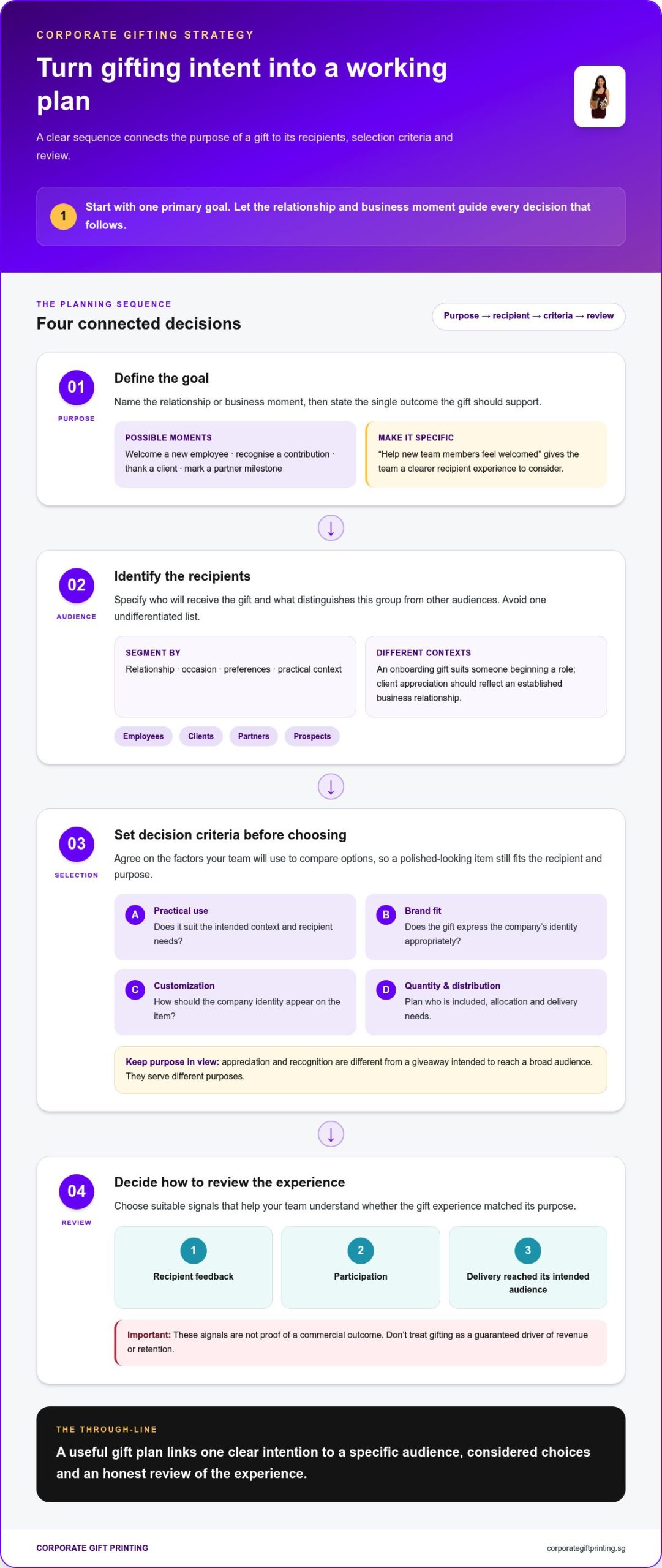
Use this sequence to turn your intention into a working plan:
- Define the goal. State the relationship or business moment and the single outcome the gift should support.
- Identify recipients. Specify who will receive it and what distinguishes this group from other audiences.
- Set decision criteria. Agree on practical use, brand fit, customization, quantity planning, and distribution needs before selecting an item.
- Decide how to review results. Choose suitable signals, such as recipient feedback, participation, or whether the delivery reached its intended audience. Don’t present these as proof of a commercial outcome.
How should you organize recipient groups and the brief?
Employees, clients, partners, and prospects have different relationships with your organisation, so avoid putting them on one undifferentiated recipient list. Segment each group by relationship, occasion, preferences, and practical context. An onboarding gift should suit someone beginning a role, while a client appreciation gesture should reflect the nature of an established business relationship. These distinctions help the team choose with care instead of relying on one gift for every audience.
Put the decisions in a concise written brief that internal stakeholders can follow. Include:
- Purpose and audience: the primary goal, recipient group, and occasion.
- Brand expression: how the company’s identity should appear, including customization or printing requirements.
- Use and suitability: the intended context and relevant recipient preferences or practical needs.
- Quantity and distribution: who is included, how gifts will be allocated, and the delivery details your team must plan around.
- Review approach: what feedback or observations will inform future decisions.
For a premium objective, such as acknowledging an important milestone or strengthening a valued partnership, explore this guide to luxury corporate gifts as one input to your planning. Corporate Gift Printing sources and customizes corporate gifts, including branded bags, electronics, and travel accessories. Its custom sourcing and printing for corporate gifts can help align a selected item with your purpose and recipient.
Choose Corporate Gifts by Recipient, Usefulness, and Brand Fit
A suitable gift should make sense for the recipient and the moment it marks. The strongest choice fits both the recipient’s context and the relationship’s purpose. Before making a selection, consider what the item communicates, whether recipients can use it, and whether your team can brand and distribute it consistently.
Use the comparison below to turn your corporate gifting strategy 2026 into practical selection criteria. Treat each category as a starting point, then assess it against the specific audience and occasion.
| Gift category | Recipient fit and practical use | Brand alignment and customization | Distribution considerations |
|---|---|---|---|
| Bags and pouches | May suit employees, clients, or event attendees who can use them for work or everyday carry. | Consider how printed branding sits on the item and whether its style reflects your brand. | Plan quantities and how items will be allocated across recipient groups. |
| Electronic gifts | Can be relevant for recipients whose work or routines make technology-related items useful. | Keep the brand treatment clear and appropriate to the item’s design. | Consider how items will be packed, assigned, and delivered to intended recipients. |
| Travel accessories | May fit a business travel occasion or a recipient group that travels for work. | Choose a brand expression that feels considered in a professional setting. | Account for whether gifts will be handed over directly or sent to recipients. |
| Business stationery | Can support desk-based work, onboarding, or professional recognition. | Align the design and brand details with your established corporate presentation. | Plan distribution around the intended workplace or recipient group. |
| Luxury corporate gifts | May suit a significant client or partner relationship where a more elevated gesture is appropriate. | Use restrained customization that preserves the considered feel of the gift. | Coordinate recipient lists and presentation carefully. |
How can you assess whether a gift feels relevant?
Picture the recipient using the item. Who will use it, when might it be useful, and does it suit the occasion? Assess practical fit for work, travel, onboarding, recognition, or client relationships. A travel accessory may fit a business travel context, while stationery may be more relevant to desk-based work. Use these as prompts, not assumptions: preferences differ, so don’t expect one gift or customization style to suit every audience.
How should branding support the gift rather than dominate it?
Branding should feel considered, not like an interruption. Match logo placement and visibility to the item’s design and material, and keep colours, identity, and messaging consistent with your company’s established presentation. The goal is an item that remains useful while expressing who gave it. For audiences where professional writing materials are a natural fit, the business stationery guide offers relevant selection ideas.
Plan 2026 Gifting Execution, Inclusion, and Measurement
A thoughtful choice still needs careful execution. Map each initiative from approval and selection through customization, distribution, recipient experience, and review. Teams may work across different schedules and observe different occasions, so plan communications around your organisation’s calendar instead of assuming one date or celebration suits everyone. Assign an owner and set out the sequence of tasks so the gift reaches recipients as intended.
What belongs in a corporate gifting campaign checklist?
Use a shared checklist to keep decisions visible and hand-offs clear. For a corporate gifting strategy 2026, record the objective, recipient groups, selected gift category, branding requirements, planned quantities, approval status, and distribution method. Identify dependencies early, including finalizing the recipient list, approving branding, coordinating production, and preparing delivery details. Build the schedule around those steps rather than assuming a fixed production or delivery timeline.
- Approval: Confirm the initiative’s purpose and who is responsible for approving the selection and branding.
- Recipient details: Organise recipient groups and distribution information, limiting access to those who need it.
- Branding and quantities: Align customization with the approved brand presentation and planned allocation.
- Communications: Assign an owner to explain the gesture, coordinate recipient updates, and respond to questions or delivery issues.
- Review: Set a date to collect feedback and assess the initiative against its original objective.
How can you make gifting more inclusive and useful?
Consider whether recipients can access, carry, understand, or practically use the item. A standard choice may not suit every person or work context, so consider alternatives that preserve the intent of the gesture. Where relevant, account for dietary requirements, cultural considerations, accessibility, and individual preferences without making assumptions based on someone’s background. A discreet way to share preferences or request an alternative can help recipients feel respected without requiring them to explain personal details publicly.
Timing and communication matter, too. Tell recipients what the gift is and how it will be distributed, and consider whether the proposed occasion is appropriate for the intended group. If a physical item may not be useful to everyone, plan a considered alternative rather than making the recipient feel singled out. Inclusion is part of the experience, not an afterthought.
Review results in proportion to the goal. Participation may help assess reach; voluntary feedback can show whether the item felt useful or appropriate; and objective-specific indicators can help assess whether an onboarding or recognition initiative reached its intended audience. Protect privacy by collecting only relevant feedback and looking for patterns across responses, rather than drawing firm conclusions from one comment. These signals can guide the next campaign, but they don’t establish that gifting caused revenue, retention, or other business outcomes.
Corporate Gift Printing brings custom sourcing and branded presentation together to plan and customize corporate gifts with recipient needs and campaign details in view.
Turn Your Corporate Gifting Strategy into a Cohesive Brand Experience
A cohesive gift programme feels intentional at every stage. The purpose shapes the audience, the audience informs the item, and the presentation carries the company’s identity without distracting from the gift’s usefulness. In a strong corporate gifting strategy 2026, branding, selection, distribution, and review work together rather than operating as separate tasks.
What does a well-aligned gifting experience look like?
Consistency doesn’t mean giving everyone the same thing. It means each gift connects to the relationship it recognises and reflects the same standard of care. The recipient should understand the gesture, be able to use the item in a relevant context, and experience branding that feels considered, from the first impression through to everyday use.
Illustrative example: A company wants to welcome new team members and help them feel connected to its identity. It selects a practical bag suited to their work context, applies branding in a way that complements the design, and includes a brief welcome message. The gift’s function, presentation, and message reinforce the onboarding purpose. This example is hypothetical; the right choice depends on the organisation, audience, and brief.
Execution matters, too. A suitable item can lose its meaning if recipients don’t know why they received it or if distribution feels confusing. Coordinate the handover or delivery with clear, appropriate communication, and use recipient feedback to learn whether the experience matched the intention. Review the whole journey, not just the finished item.
How can a business move from plan to branded gift?
Begin with the approved brief, then translate it into a suitable gift category and a clear customization approach. A work-focused initiative might point toward business stationery or electronics; a travel-related gesture could suit travel accessories. Bags and pouches can support other practical contexts, while luxury corporate gifts may suit a more elevated relationship moment. These categories are options, not a fixed package. Let the recipient and objective guide the choice.
Next, decide how the brand should appear on the selected item. Keep the company’s identity and message consistent while adapting placement and visibility to the item’s form and intended impression. Custom sourcing connects the brief to an appropriate category, while customization and printing apply the approved branding to the physical gift. This turns a strategic intention into a tangible expression of the company’s identity and care.
Before distribution, compare the final selection and presentation with the original purpose. Confirm internally that the intended audience, branding, quantities, and delivery plan remain consistent with the approved brief. After recipients receive their gifts, review relevant feedback and observations to refine future decisions. The result is a repeatable process that supports brand coherence without making every gift identical.
Corporate Gift Printing provides custom corporate gift solutions, sourcing and printing branded items to bring your brief, recipient needs, and brand presentation together.
Make Your Next Gifting Initiative More Intentional
A thoughtful gesture begins with a clear intention, but its impact also depends on how carefully that intention carries through to the recipient. Use your corporate gifting strategy 2026 as a working guide: after each initiative, note what felt relevant, where coordination could improve, and what you would refine next time. These observations can help your team make future decisions with greater confidence and consistency.
You don’t need to perfect every detail before taking the next step. Start with one upcoming business moment, define the relationship you want to recognise, and shape a gift experience that feels appropriate to the people receiving it. A considered brief and careful execution can make a branded gift feel like a genuine expression of care rather than a routine transaction.
Explore custom corporate gift solutions from Corporate Gift Printing to bring your next gifting idea from plan to a professionally branded item. Make your next gesture a considered expression of the relationships your business values.
Frequently Asked Questions
Is corporate gifting still effective in 2026?
Yes, corporate gifting can support business relationships when the gesture feels relevant and considerate, though no gift can guarantee a particular business outcome. In a corporate gifting strategy 2026, assess effectiveness through the recipient experience: did the gift suit the moment, communicate appreciation clearly, and reflect the relationship appropriately? A short, voluntary feedback question after an initiative can offer useful insight without assuming one response represents everyone.
How far in advance should a company plan corporate gifts?
Start planning as soon as the occasion or business need is known, and work backwards from the intended handover or delivery date. Allow time for internal approvals, confirming recipient details, selecting and customizing the gift, and coordinating distribution. Custom-branded items involve several decisions, so avoid leaving the brief until the last minute. For recipients across Singapore, map communications and delivery arrangements against your organisation’s calendar.
How much should a company spend on corporate gifts?
Set the budget according to the initiative’s purpose, recipient group, and approved company spending limits, rather than choosing an item first. Establish a per-recipient or campaign cap in S$ and account for the full planned spend, including customization, presentation, and distribution. A modest gesture can feel considered if it suits the occasion; a higher spend alone doesn’t make a gift more meaningful. Apply the same approval process consistently across comparable initiatives.
Can corporate gifts be personalized for different recipients?
Yes. Personalization can range from adapting the message or presentation for a recipient group to adding details for a particular individual, where appropriate. For example, a welcome note can speak to new employees, while a client message can acknowledge a shared milestone. Keep personal details accurate and suitable for the relationship, and use a consistent brand standard so tailored touches feel thoughtful rather than uneven or overly familiar.
What should a company avoid when choosing corporate gifts?
Avoid selecting an item solely because it is popular, easy to brand, or suitable for broad distribution. It may not suit the recipient’s needs or the relationship. Also be cautious with prominent logos, assumptions about cultural or personal preferences, and gifts that could conflict with a recipient organisation’s gift-acceptance policies. A quick review of the audience, context, and intended use can reveal mismatches before the gift is prepared.
How can a business make corporate gifts feel sincere rather than promotional?
Make the recipient, not the sales message, the focus. Briefly explain why you’re giving the gift, such as thanking someone for their collaboration or recognising a contribution, and avoid attaching an immediate sales request. Keep branding proportionate to the item and let a specific, genuine message carry the meaning. Thoughtful timing and a personal note can help distinguish appreciation from a giveaway designed mainly to attract attention.