What makes a trade show giveaway worth taking home? The strongest trade show swag ideas Singapore exhibitors choose are useful during the event and still relevant afterward. A familiar freebie may attract attention at the booth, but if it does not suit the recipient, it can be forgotten just as quickly.
Choosing swag means balancing audience fit, practical use, brand visibility and distribution. Start by deciding what the giveaway should support: a conversation with booth visitors, a brand reminder after the event or a more personal gesture for key prospects. Then choose an item and branding approach that fit that purpose.
This guide compares customized bags and pouches, electronic gifts, travel accessories, business stationery and luxury corporate gifts. Use the comparisons and planning steps to narrow your shortlist, estimate quantities by recipient group and prepare branding that suits the item rather than overpowering it.
Key Takeaways
- Balance booth appeal with everyday usefulness when narrowing your trade show swag ideas Singapore shortlist.
- Compare categories by audience fit, likely repeat use, logo visibility and ease of distribution.
- Define the campaign objective and recipient groups before estimating quantities.
- Coordinate product selection, branding and production so the finished giveaway reflects your company clearly.
- Consider one main giveaway for visitors and a more tailored gift for a specific audience segment.
What makes trade show swag ideas in Singapore work beyond the booth?
An eye-catching giveaway can draw someone to your booth, but its longer-term usefulness depends on whether the recipient has a reason to use it. The best trade show swag ideas Singapore exhibitors choose balance immediate appeal with relevance after the event. Promotional merchandise includes branded items used to promote an organisation. At a trade show, the item also becomes part of a visitor’s experience with your brand.
Start with the recipient’s situation. A bag or pouch can help visitors carry brochures and notes around the exhibition. Business stationery may be a better fit for people who take notes during meetings. Perceived quality and function should match: a useful item feels more considered when it is suitable for its intended purpose. Clear branding completes the choice. A legible logo and focused message help people connect the item with your company without making it less appealing to use.
Not every gift has to serve the same role. A broad visitor giveaway should be easy to carry and relevant to a wide audience. Electronic gifts or luxury corporate gifts may be more suitable for qualified prospects or business contacts in a focused conversation. Define success by the campaign objective, such as encouraging booth conversations, supporting brand recall or providing a useful follow-up touchpoint. These are aims, not guaranteed results.
How should a giveaway support your exhibition objective?
Decide what you want the item to do before choosing a product. For broad booth engagement, look for a portable giveaway visitors can take with them, such as a branded bag or pouch. If the aim is to support a focused business discussion, choose a more considered gift suited to that recipient. Give each item one clear role and message. This helps the branding reinforce the conversation instead of adding decoration without purpose.
What makes trade show swag worth keeping?
Consider whether recipients can use the item at work or in daily life, carry it comfortably and see it as relevant to them. Check that the logo remains legible at its intended size, but let the item’s function and appearance lead. Repeated use can create more opportunities for people to notice your branding when the design suits the recipient and the item serves a practical need. It may encourage familiarity, but it cannot guarantee recall.
Which trade show swag ideas in Singapore fit different audiences?
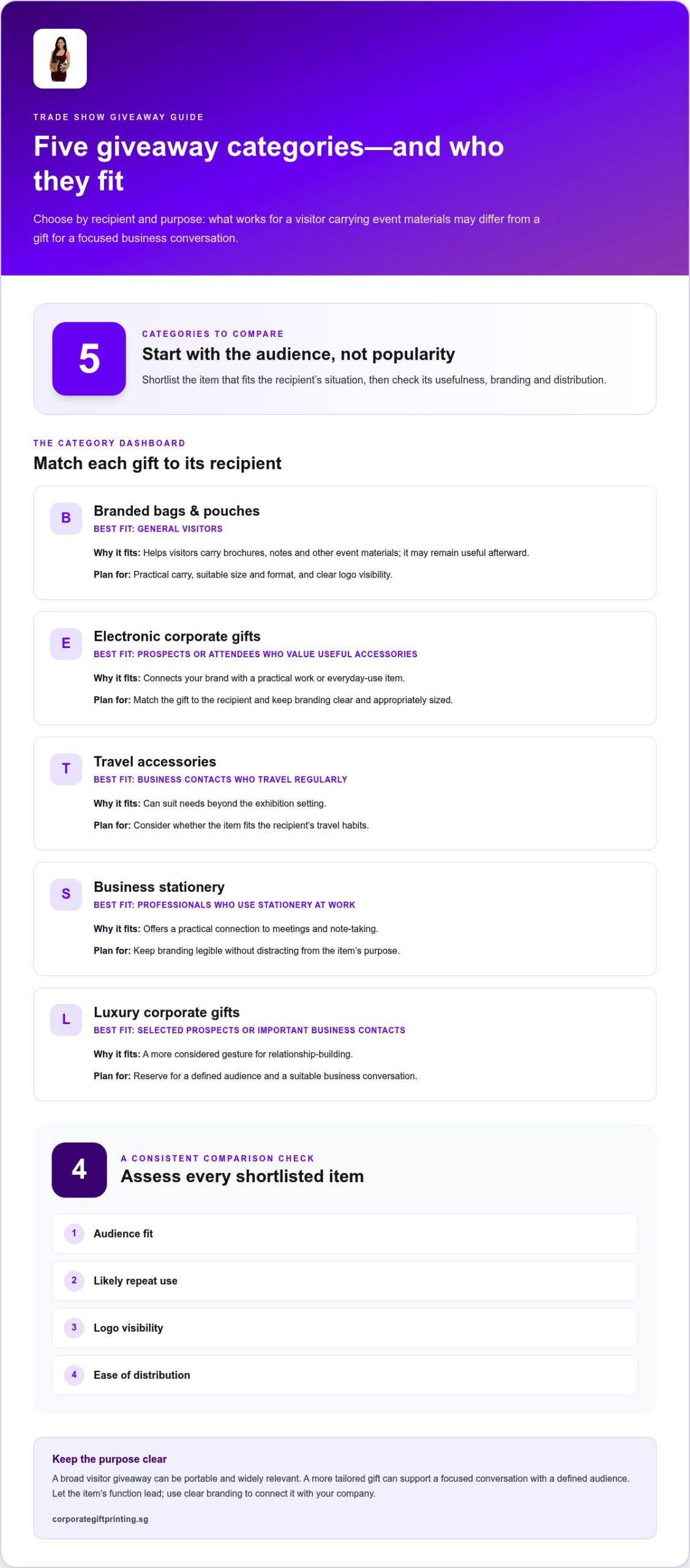
The right giveaway depends on who will receive it and what you want it to do. A visitor collecting brochures has different needs from a prospect having a detailed business discussion. Use the comparison below to shortlist trade show swag ideas Singapore audiences may find relevant, rather than choosing by popularity alone.
| Item category | Suitable audience | Main advantage | Planning consideration |
|---|---|---|---|
| Branded bags and pouches | General visitors carrying event materials | Useful during the exhibition and potentially beyond it | Choose an option that’s practical to carry and gives the logo clear visibility |
| Electronic corporate gifts | Prospects or attendees who value useful everyday accessories | Connects your brand with a practical work or daily-use item | Match the gift to the recipient and keep branding clear and appropriately sized |
| Travel accessories | Business contacts whose work involves regular travel | Can suit needs beyond the exhibition setting | Consider whether the item fits the recipient’s travel habits |
| Business stationery | Professional audiences who use stationery in their daily work | Offers a practical connection to meetings and note-taking | Keep the branding legible without distracting from the item’s purpose |
| Luxury corporate gifts | Selected prospects or important business contacts | Creates a more considered gesture for relationship-building | Reserve for a defined audience and a suitable business conversation |
Explore branded corporate gift solutions to see how product selection and company branding can come together for an exhibition campaign.
When do branded bags and pouches make a practical giveaway?
Visitors often need a convenient way to carry brochures, notes and other event materials, which makes bags and pouches practical during the exhibition. Their use may continue afterward if the size, format and design suit the recipient. They can work as a broad visitor giveaway, while a more considered item may be better suited to priority contacts. For further guidance, see The Executive Guide to Customized Bags and Pouches.
When do tech, travel and stationery gifts suit the audience?
Electronic gifts can suit recipients who appreciate useful accessories for work or everyday life. Travel accessories are a natural fit for contacts who travel regularly, while business stationery may appeal to people who take notes or organise their work on paper. Match the category to the recipient’s likely needs, then apply branding that supports the item’s purpose.
Luxury corporate gifts are a selective option, not a default for every visitor. Consider them for a defined group of prospects or business contacts when the gift complements a focused conversation and the relationship you want to build.
How do you compare trade show swag by usefulness, visibility and brand fit?
Compare every shortlisted item using the same criteria. Ask whether it suits the recipient, has a realistic chance of being used again, displays your logo clearly and can be distributed smoothly at the exhibition. This framework helps you assess trade show swag ideas Singapore businesses might otherwise judge on appearance alone.
- Recipient relevance: Does the item fit the visitor’s work, interests or reason for attending?
- Repeated-use potential: Is there a practical reason to keep using it after the event?
- Logo visibility: Can people see and recognise the branding during ordinary use?
- Distribution ease: Is it convenient to carry, store and hand out to the intended group?
Use the criteria together. A compact item may be easier to distribute to a broad audience, while a more substantial or premium gift may make more sense for fewer, carefully selected recipients. Compare options against your campaign’s planned spend, but do not assume a higher-cost item will automatically make a stronger impression. The best fit balances usefulness, brand alignment and practical distribution.
How can you assess usefulness and brand visibility together?
Picture the recipient leaving the exhibition. Can you name a likely situation in which they would use the item? Then consider where the logo appears and whether it will remain legible in that setting. Branding should be noticeable without dominating the design. A clear, well-placed mark on an item that suits the recipient can support recognition while keeping the giveaway useful and attractive.
Be precise with product claims. Describe sustainability, durability or performance only when the selected item’s specifications support those claims. Otherwise, focus on verifiable qualities such as intended use, format and branding treatment.
How should you match gift value to the recipient?
Broad-audience handouts should be practical and simple to distribute. Gifts for priority prospects or partners can be more selective and suited to a focused conversation. Choose an item that reflects the relationship and the formality of the interaction. Luxury corporate gifts may suit a considered business gesture, but they need not be the default for every visitor. For more guidance, see Luxury Corporate Gifts: 2026 Guide to Memorable Gifting.
Before finalising your shortlist, give each item a clear role. If it does not serve the audience, support the campaign message or make sense to distribute, reconsider its place in the plan.
How do you plan and customise exhibition giveaways for a Singapore event?
A considered giveaway starts with a clear brief, not a logo file. Before deciding on quantities, map out the recipient groups and how each item will be distributed. A giveaway for general visitors and a gift reserved for priority prospects require different quantity estimates and planning. This creates a practical route from shortlisted trade show swag ideas Singapore to branded items that support the exhibition campaign.
- Define the audience. Identify who will receive the giveaways, such as general visitors, qualified prospects or existing business contacts.
- Set the objective. Decide whether the item should encourage booth conversations, support a follow-up or offer a useful brand reminder.
- Shortlist categories. Compare bags and pouches, electronic gifts, travel accessories, stationery or luxury corporate gifts against the audience and objective.
- Prepare the branding. Gather approved logo files, brand colours and artwork instructions, along with guidelines for how the identity should appear.
- Coordinate production. Confirm the distribution approach, who is responsible for artwork approval and the event date. Plan a realistic schedule that leaves room for review.
What should your giveaway brief include?
Make the brief specific enough to guide decisions. Include the audience, campaign purpose, event date and intended distribution method for each item. Add the preferred product category, branding priorities and relevant brand guidelines. Name the person or team responsible for approving the artwork and final branded item. Clear ownership keeps feedback organised and reduces the risk of conflicting instructions as the project progresses.
How can branding support the item rather than overwhelm it?
Choose logo size and placement in relation to the item’s shape and intended use. Good colour contrast can help the mark remain legible, while a restrained treatment lets the item stay attractive to recipients. Keep the artwork aligned with your brand identity and campaign message instead of trying to fit every detail onto the giveaway. Customisation should suit the selected item and its specifications.
Allow time for your team to review the artwork and branded item before the exhibition. A practical schedule helps coordinate decisions without assuming a particular production or delivery timeframe. From choosing the right category to applying your company branding, plan branded gifts for your next exhibition as one connected process.
Turn your trade show swag shortlist into a cohesive branded-gift plan
A shortlist becomes more useful when every item has a clear role in the exhibition campaign. Choose one primary giveaway for the wider visitor audience, then consider an optional audience-specific gift for priority prospects or business contacts. For example, branded bags and pouches could serve general attendees, while a more considered item is reserved for a focused conversation. This keeps your selection purposeful instead of turning the booth into a collection of unrelated giveaways.
How can a consistent giveaway selection strengthen your brand impression?
Consistency comes from shared intent, not identical artwork placement. Choose items that reflect the same professional identity and campaign purpose, then carry your logo, colours and message across each one in a way that suits its format. The logo may need a different position on a pouch than on stationery, but coordinated branding can still make the items feel connected. Thoughtful execution supports a coherent impression without promising a specific number of leads or sales.
As you refine your trade show swag ideas Singapore, check that each item earns its place. It should suit its recipient, contribute to the campaign and fit naturally into the booth experience. If two options serve the same purpose, decide whether one can do the job more clearly.
What should you finalise before moving from shortlist to order?
Before proceeding, align the practical details so the selected items and branding can move forward together:
- Item categories and recipients: Confirm the primary giveaway, any audience-specific gift and who is intended to receive each.
- Quantity assumptions: Estimate quantities based on recipient groups and the planned distribution approach.
- Artwork approvals: Gather approved logo files and brand guidelines, and identify who will approve the artwork and final branded item.
- Exhibition schedule: Work back from the event date to set internal review points and coordinate production and delivery planning.
Corporate Gift Printing sources and customises corporate merchandise, then applies company branding through logo printing across categories including bags and pouches, electronic gifts, travel accessories, stationery and luxury corporate gifts. Product selection and branded execution come together in one process, helping you turn a considered shortlist into a cohesive gift plan. Discuss your branded trade show gifts for your exhibition.
Make Your Exhibition Giveaway Plan Count
The most effective trade show swag ideas Singapore teams choose start with a clear purpose. Match the item to its recipient, campaign objective and practical use. Comparing usefulness, logo visibility and ease of distribution helps narrow the options, while coordinated branding connects each giveaway to the wider exhibition experience.
From bags and pouches to electronic gifts, travel accessories, stationery and luxury corporate gifts, choose the item that feels considered for its audience. Corporate Gift Printing sources and customises corporate gifts and prints company logos on selected merchandise, connecting product selection with branded execution.
Whether you are preparing a broad visitor giveaway or a more selective gift for key contacts, thoughtful planning can make the gesture feel purposeful. Plan thoughtful branded gifts for your next exhibition with Corporate Gift Printing.
Frequently Asked Questions
What are the most popular trade show swag ideas in Singapore?
Common trade show swag ideas Singapore exhibitors consider include branded bags and pouches, electronic corporate gifts, travel accessories and business stationery. Each has a different use: bags can help visitors carry event materials, stationery can suit professional audiences, and travel accessories may be relevant to frequent travellers. Instead of choosing an item only because it is familiar, compare its usefulness for your audience, ease of distribution and fit with your brand.
What makes a good trade show giveaway?
A good trade show giveaway is relevant to its recipient, practical to use and clearly connected to your brand. Consider whether visitors have a reason to keep it after the exhibition, whether it is convenient to take away and whether the logo is legible without overwhelming the design. A well-matched item can support a professional impression, but no giveaway can guarantee brand recall or business results.
How do I choose trade show swag for my target audience?
Start by identifying who you expect to meet and what you want the giveaway to support. General visitors may appreciate an easy-to-carry item, while a focused business conversation may suit a more considered gift. Match the category to recipients’ likely needs: stationery for people who use it at work, or travel accessories for contacts who travel regularly. Then check that the branding and distribution approach fit the campaign.
Are branded bags effective giveaways at trade shows?
Branded bags can be practical giveaways because visitors often need a way to carry brochures, notes and other event materials. Their usefulness may continue after the exhibition if the bag suits the recipient’s needs. Consider how it will be carried and whether the logo remains visible without dominating the design. Bags and pouches can suit broad visitor groups, while other items may be more appropriate for specific audiences.
Can corporate gifts help exhibitors start conversations with visitors?
A relevant corporate gift can provide a natural opening for conversation, especially when it connects to the visitor’s interests or a campaign message. For example, an exhibitor might introduce a practical item while explaining how it relates to the brand. The gift should support a genuine exchange, not replace one. Its ability to prompt discussion depends on the context and how the booth team presents it.
How many trade show giveaways should I prepare?
Estimate quantities by mapping recipient groups and deciding how each item will be distributed. A giveaway intended for all booth visitors needs a different quantity plan from a gift reserved for qualified prospects or business partners. Use expected attendance, your team’s distribution approach and each item’s role to inform the estimate. Avoid treating every shortlisted gift as a universal handout if it has a more selective purpose.
When should I plan branded merchandise for an exhibition?
Start early enough to align item selection, branding approvals and production with the exhibition date. Build a schedule around internal decisions, including who will approve the artwork and final branded item, and leave room for review before production proceeds. Include the event date and distribution plan in the brief. This gives your team a clear basis for coordinating the work without assuming a fixed production timeframe.