What if the most memorable corporate gift wasn’t the most lavish one, but the one your recipient used again and again? Sustainable corporate gifts can turn environmental intent into a tangible expression of your brand, but only when usefulness, durability and credible material claims come together. A flimsy item with an oversized logo risks saying the opposite of what you mean.
Choosing a lower impact material can raise practical questions: Will the item last? Can it carry your branding clearly? Can its environmental claims be verified rather than simply printed on a tag? Start with the item’s function and construction, then consider its materials and the evidence available to support claims about them.
This guide covers material choices such as recycled PET, bamboo and wheat straw, along with practical questions to ask before selecting a gift. From customized bags and travel accessories to electronics and stationery, you’ll find ways to connect environmental priorities with items recipients can use. The goal is to make a considered choice that reflects your brand and serves a real purpose.
Key Takeaways
- Choose gifts for lasting usefulness and durability, not just their sustainability appeal.
- Learn how materials such as RPET and wheat straw differ, and what questions can help you assess their environmental claims.
- Explore five gift categories that can connect environmental priorities with a polished professional identity.
- Assess logo placement and branding methods for different materials before confirming an order.
- Use sustainable corporate gifts to express your brand values, while making informed sourcing decisions that support your broader ESG goals.
Why Sustainable Corporate Gifts are the New Standard for 2026
A corporate gift carries more than a logo. It signals what a company values and how carefully it considers the people receiving its gifts. Sustainable corporate gifts are branded items selected with the aim of reducing environmental impact while providing genuine professional utility. The strongest choices bring those aims together through thoughtful materials, practical function and durability.
This approach moves away from disposable promotional items chosen mainly for short term novelty and toward gifts recipients can use over time. A well made bag, travel accessory, electronic gift or piece of stationery can keep a brand visible through everyday use. An item that breaks quickly or goes unused may undermine the message it was meant to convey. Durability alone does not determine sustainability, but it is a practical place to start.
Consistency matters, too. A gift can support a sincere brand message when its quality and sourcing choices reflect the values a company communicates elsewhere. Corporate gifting can be one practical expression of Corporate Social Responsibility (CSR), connecting broad commitments to a tangible gesture of care. It does not replace an ESG strategy or prove environmental performance on its own, but it can make a company’s intentions more visible to employees, clients and partners.
The ROI of Eco-Conscious Branding
The return on a considered gift is not limited to immediate attention. An item that earns a place in someone’s daily routine can sustain brand recall longer than a novelty item that is quickly discarded. Usefulness also communicates respect: the recipient sees that the company considered their needs, not just the chance to display a logo. That thoughtful choice can help reinforce trust with employees and business partners, though it should not be treated as a guaranteed driver of retention or loyalty.
Poor quality can also mean replacements, unused stock and unwanted waste. Before ordering, ask whether the item suits its intended recipient, whether its construction is appropriate for regular use, and whether the branding fits the product’s purpose.
Singapore’s National Shift Toward Green Procurement
Organizations procuring in Singapore can consider sustainable gifting alongside broader corporate sustainability goals and circular economy principles. Look for products designed for continued use, and ask clear questions about their materials and sourcing. Do not describe a gift as certified or environmentally preferable unless supporting documentation verifies the specific claim.
Transparency matters across markets. For example, the EU Empowering Consumers for the Green Transition Directive takes effect on September 27, 2026, and addresses vague environmental claims without reliable, verifiable evidence. Its rules are not a blanket requirement for every Singapore purchase, but they underline a useful procurement discipline: ask suppliers what a claim means, what evidence supports it, and whether that evidence applies to the specific item. This helps move green gifting beyond appearances and toward choices you can explain with confidence.
Understanding Eco-Friendly Materials: From RPET to Wheat Straw
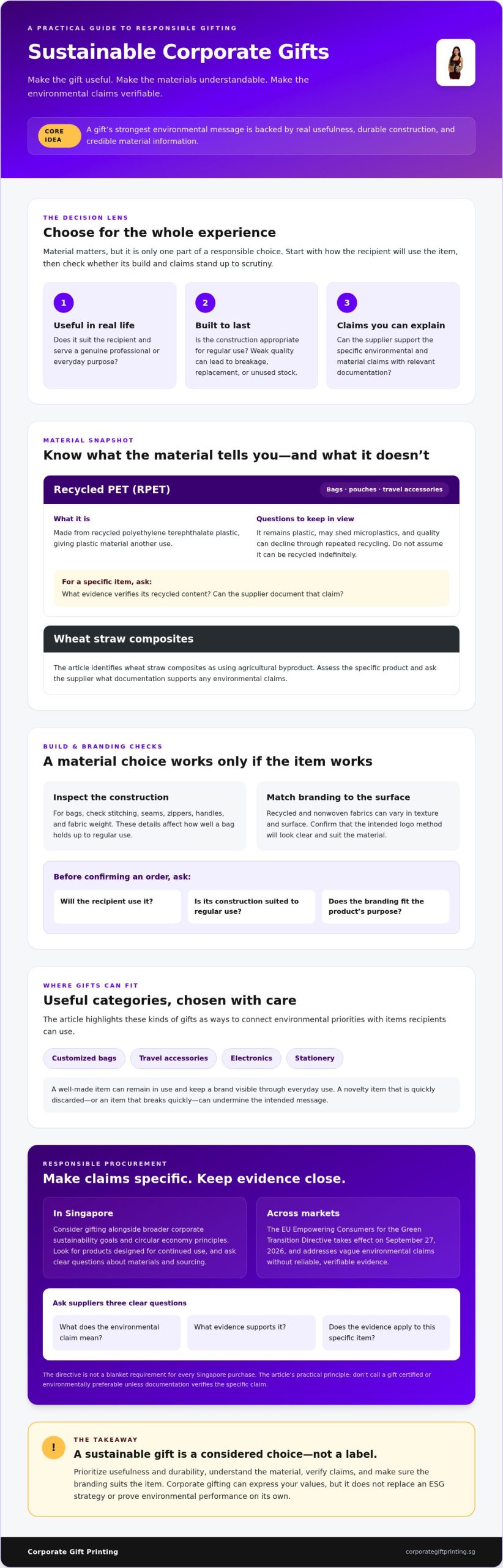
Material names can point you in the right direction, but they do not tell the whole story. When assessing sustainable corporate gifts, consider what a product is made from, how the material is processed, how long the item is likely to last, and what evidence supports its environmental claims. The promotional products industry sustainability resource from PPAI offers industry context, while supplier documentation can help you assess a specific product.
Textiles and Bags: The Power of Recycled Fibres
Recycled PET, or RPET, is made from recycled polyethylene terephthalate plastic and can be used in bags, pouches and travel accessories. It gives plastic material another use, but it remains plastic: it may shed microplastics, and its quality can decline through repeated recycling. Do not assume it can be recycled indefinitely. Ask what evidence is available for the recycled content of the specific item, and whether the supplier can document the claim.
For a bag, look beyond its recycled fibre content. Stitching, seams, zippers, handles and fabric weight all affect how well it stands up to regular use. A durable design is more likely to remain useful, while weak construction can undercut the value of the material choice. Recycled and nonwoven fabrics can also vary in texture and surface, so check that the intended logo method will appear clear and suit the material.
Electronics and Stationery: Reducing Material Impact
Wheat straw composites use agricultural byproduct, often combined with polymers to improve strength. They may be used in electronic casings or stationery, but a wheat straw component does not make an entire power bank or charging cable biodegradable. Ask which parts contain the material, what else is in the composite, and how the item should be disposed of at the end of its useful life.
Bamboo is fast growing and often marketed as a renewable option, yet its sustainability depends on processing and transport. Turning bamboo into fabric can involve chemical intensive steps, and shipping from major production regions adds to its footprint. Treat “bamboo” as a reason to ask more about sourcing, not as proof of a product’s overall impact.
For paper stationery, look for documented FSC certification when responsible forest sourcing is a priority. Cork can offer a distinctive natural finish for desk accessories, while bamboo may suit selected stationery designs. Assess both for construction, finish and intended use. Explore sustainable business stationeries for ideas suited to everyday office routines.
A sourcing partner can help match material priorities with branded bags, electronics or stationery, while considering material claims and logo suitability. If you’re comparing options, review customized corporate gift options with the item’s intended use and materials in mind.
The 2026 Sustainable Gift Roundup: 5 Categories for Every Brand
The right gift is useful first and symbolic second. These five categories offer ways to pair professional utility with more considered material choices. Treat the materials below as starting points, not automatic proof of sustainability. Before selecting an item, confirm its construction, sourcing evidence and expected lifespan.
- Travel gear: RPET organizers, luggage tags and laptop sleeves can suit employees who travel or work across locations. Check seams, closures and fabric quality to assess whether the item is built for regular use.
- Tech accessories: Charging accessories or protective pouches featuring wheat straw composites can make practical gifts. Ask which components use the composite. A material in the casing does not establish the environmental profile of the complete electronic item.
- Office stationery: Consider notebooks with verifiable responsible sourcing documentation and pens designed for comfortable, everyday use. Explore branded pens in Singapore as one stationery option, and assess material claims alongside writing quality and branding clarity.
- Reusable lifestyle essentials: Glass or bamboo drinkware may suit recipients who will use it regularly. Consider care requirements, portability and durability, not just the material’s natural appearance.
- Luxury eco-gifts: Cork accessories or products made with upcycled materials can create a distinctive, refined impression. Verify the material description and finish, and choose a useful format rather than relying on a “premium” label alone.
High-Impact Bags and Travel Accessories
For a hybrid workforce, an RPET laptop sleeve or organizer can support daily movement between home, office and meetings. For partners who travel, a well constructed travel pouch offers practical storage without needing prominent branding. Canvas is another option to consider, but confirm its fibre composition and sourcing rather than assuming the material is sustainable by default. Reusable, high utility items can keep a brand present through routine use and support a relationship, but they do not guarantee client retention.
Eco-Friendly Office Essentials
Stationery can fit naturally into onboarding, internal programmes and corporate events because it has a place in everyday work. When comparing pens, assess bamboo and recycled plastic options based on documented material claims, writing performance, durability and the finish required for your branding. A material choice matters, but a pen that works well and gets used is more intentional than one that is quickly set aside. Calendars can also provide recurring brand visibility. Consider whether calendar printing Singapore fits your communication needs, and ask about materials and construction before ordering.
From customized bags and travel accessories to electronics and business stationery, the strongest sustainable corporate gifts connect recipient needs with clear sourcing decisions. A considered shortlist turns a broad environmental intention into a professional gift that feels useful, consistent and well made.
Best Practices for Branding Sustainable Merchandise
A sustainable material deserves branding that suits its character and holds up through regular use. With sustainable corporate gifts, logo application is part of the product’s lifespan: poor adhesion, fading or an unsuitable finish can shorten the item’s useful life. Match the branding method to the material, then review a sample for appearance and durability before confirming an order.
Precision Printing on Recycled Surfaces
Recycled fabrics can have a textured or variable surface, while wheat straw composites may differ in color and finish. These qualities can affect how a logo appears. Water based inks may be an option for some fabrics, and laser engraving may suit certain bamboo or wood surfaces, but neither method is right for every product. Ask which process suits the specific material and request a sample to assess clarity, color and wear.
Keep brand guidelines intact while adapting artwork to the surface. Fine details or small text may be less legible on textured fabric, so a simplified mark or carefully sized logo can preserve recognition without overwhelming the product. Minimal branding can feel more considered on premium gifts, while leaving the material and craftsmanship visible.
Packaging and Presentation: The Final Eco-Step
A gift’s footprint does not end with the item. Review its packaging and presentation as part of the same procurement decision. Where suitable, consider recycled kraft paper, reduced packaging and inks with documented composition, such as soy based inks. Do not assume a material is environmentally preferable based on its name alone. Ask suppliers for evidence when a claim matters to your sustainability goals.
The unboxing experience can communicate care without adding unnecessary layers. A concise note can explain the material choice in specific, verifiable terms, while reusable or recyclable packaging can help avoid a mismatch between the gift’s sustainability message and its presentation. Consider the full journey: product, logo application, packaging, delivery and eventual disposal. Each stage can affect whether the item remains useful and whether its environmental claims are credible.
Before approving a design, check that the product suits its intended use, the branding remains legible on the chosen surface, and the packaging aligns with your procurement criteria. For help translating your brand guidelines into customized bags, electronics or stationery, explore branded corporate gift options.
Elevating Your ESG Strategy with Corporate Gift Printing
A gifting programme can make your company’s values tangible, but the gift itself cannot substantiate an ESG commitment. Credible execution depends on choosing products that fit their recipients, checking material claims and aligning customization with your brand standards. Corporate Gift Printing sources and customizes branded bags, electronics, travel accessories and business stationery for corporate gifting needs.
Start with your goals. Identify who will receive the gifts, how they’ll use them, and which sourcing criteria matter to your organization. Then compare suitable products, review available material information and assess how the logo will appear on each surface. This approach keeps environmental priorities connected to professional identity without treating a “green” label as proof on its own.
A Partner in Professional Identity
Ethical sourcing and an elegant presentation need not be competing priorities, but claims should be supported by product specific information. Ask what documentation is available for a material and whether it applies to the item being considered. Then assess construction, finish and branding together. For luxury corporate gifts, restrained customization can preserve a refined presentation. For a larger employee or client programme, consistent product selection and logo application can help create a cohesive experience. Corporate Gift Printing focuses on corporate gifting rather than event management services.
The Corporate Gift Printing Advantage
Material choice affects more than appearance. Recycled fabrics, composite surfaces and other nontraditional materials may call for different branding considerations. Corporate Gift Printing provides sourcing, customization and printing across bags, electronics, travel accessories and stationery. When reviewing options, check how the proposed logo application suits the material and confirm the finished appearance before proceeding.
For programmes involving recipients in multiple locations, coordinate product selection, customization requirements and delivery details early. Clear specifications help keep the process organized and reduce avoidable mismatches between the intended gift and its final presentation. Sustainable corporate gifts can contribute to a thoughtful ESG narrative, but they work best alongside your organization’s broader sourcing policies and substantiated environmental reporting.
Whether you’re planning a refined client gift or a coordinated corporate programme, explore Corporate Gift Printing’s customized corporate gift options.
Make Your Next Gift a More Considered Brand Statement
A strong gifting strategy starts with a clear match between recipient, purpose and product. The material matters, but so do durability, credible sourcing information and branding that suits the item. Together, these choices can help sustainable corporate gifts express your professional identity with care, rather than relying on an environmental label alone.
Turning that intention into a polished result takes thoughtful product selection and customization. Corporate Gift Printing sources and customizes bags, travel accessories, electronics and business stationery for corporate gifting. Start with what recipients will genuinely use, then compare material information and branding options to find a product that fits your brief.
Frequently Asked Questions
What makes a corporate gift truly sustainable?
A considered gift balances material choices with usefulness, durability and responsible sourcing. Consider what the item is made from, how it’s produced, how long the recipient is likely to use it, and what happens at the end of its life. Ask for documentation that supports specific environmental claims rather than relying on broad labels such as “eco-friendly.” No single material or certification tells the whole story.
Are sustainable corporate gifts more expensive than traditional options?
Not necessarily, but the price depends on the item, material, customization and order requirements. Compare options based on expected use and construction, not just the initial purchase price. A well made gift that recipients value may offer more lasting utility than a low quality item that is quickly discarded. Request item specific details and compare equivalent products, since a material label alone does not establish overall value.
Can I still have high-quality logo printing on recycled materials?
Yes. Logo quality depends on the surface, the branding method and the design, so recycled materials do not automatically prevent a refined result. Textured fabric may affect fine details, while composite surfaces can vary in color and finish. Ask which method suits the specific item, and review a sample for color, clarity and resistance to wear. A simplified logo can sometimes improve legibility without compromising brand recognition.
What are the most popular eco-friendly gifts for 2026?
Rather than assuming one item is universally popular, choose according to the recipient and intended use. Practical options include customized bags and pouches, travel accessories, electronic corporate gifts and business stationery. For each item, check material claims and construction, then consider whether it fits recipients’ routines. Useful, durable gifts are more likely to stay in circulation than novelty items selected mainly for appearance.
How do I verify the environmental claims of a gift supplier?
Ask for specific, product level evidence: what material the item contains, what percentage or component the claim refers to, and whether relevant documentation or certification is available. Confirm that any certificate applies to the product or material in question, rather than assuming a supplier wide claim covers every item. Also ask about packaging and expected product lifespan. If a claim remains vague or unsupported, do not repeat it in your own communications.
Is RPET material durable enough for high-end corporate bags?
RPET can be used in corporate bags, but durability depends on the complete product, not the recycled material label alone. Check fabric weight and feel, stitching, seams, handles, zippers and intended use. Ask the supplier for information about recycled content and inspect a sample where possible. RPET is still plastic, and its properties can vary, so assess both construction quality and whether the bag suits the recipient’s needs.
What is the best eco-friendly gift for C-suite executives?
The best choice is a useful, well made item that suits the executive’s role and your relationship. Consider refined travel accessories, customized bags, quality business stationery or an appropriate electronic corporate gift. Keep branding understated and check material claims before describing an item as sustainable. For a senior recipient, the finish, function and presentation should feel considered, not selected solely to display a company logo.
How can I reduce waste in my corporate gifting program?
Start by matching gifts to recipients and occasions, then choose practical items designed for repeated use. Confirm quantities against a realistic recipient list, avoid unnecessary packaging, and ask whether packaging materials can be reduced or reused. Review feedback after each programme to identify items that went unused. For branded products, prioritize durable construction and a logo treatment suited to the material, helping prevent premature wear or disposal.